Blog Posts

Mostrar mensagens com a etiqueta bio-engenharia. Mostrar todas as mensagens

quarta-feira, 22 de agosto de 2012

Patentes em Moçambique, Carrões no Brasil, e Universidades porreiras

O Instituto da Propriedade Industrial de Moçambique, não desfazendo dos outros, está bem e recomenda-se, agora lançou um Boletim, tanto em Papel como em CD.
Por terem percebido que a maior Riqueza dum País, e uma que nunca se esgota, é  a Criatividade do seu Povo, PARABÉNS!


https://www.facebook.com/pages/IPI-Instituto-da-Propriedade-Industrial-de-MZ/345062415554894


O Brasil que se convença, também, disso em vez de andar à procura do Ouro que "já nao têem", do qual 1/5 foi para Portugal, e 4/5 ficaram no Brasil... Cadê?

Eis o Ouro que nunca acaba, Brasileiros com Ideias, e é claro, Parabéns, também:


Amoritz GT apresenta seu supercarro brasileiro

Por - Leonardo Contesini
 Talvez você não se lembre dele, mas no começo de 2010 o anúncio da criação do primeiro supercarro brasileiro ganhou destaque nosprincipais sites automotivos do mundo. Não, não estamos falando do desaparecido Vorax, e sim do ambicioso projeto conhecido inicialmente como Amoritz GT DR7, que prometia algo do nível dos Koenigsegg e Pagani, usando chassi próprio e o vitaminado V10 do Dodge Viper. Depois de dois anos o carro mudou de nome e, segundo o Carsale, finalmente foi apresentado na noite de ontem (28) em São Paulo.
O DoniRosset foi idealizado pelo designer Fernando Morita em parceria com o empresário William Rosset como um presente para seu pai, Donino Rosset. Além do nome, a potência também mudou, e saltou dos sugeridos 650 cv para 1007 cv, gerados pelo V10 de 8,4 litros do Viper com um sistema twin turbo, que será montado em posição central e queimará apenas etanol.

http://m.jalopnik.com.br/amoritz-gt-apresenta-seu-supercarro-brasileiro/


Continuando nos Super-Carros, a Eslovénia também os faz... Vejam só:


Slovenia's supercar: The Tushek Renovatio T500

By C.C. Weiss

In the future, every nation on the globe may just have its own home-brewed supercar. We're getting closer every year, one country at a time. We've seen a 1,100-hp electric supercar from Croatia. Brazil and Poland have chimed in with their thoughts on supercar design. The Netherlands and Denmark have represented. Now, Slovenia has a little something to say.

http://www.gizmag.com/slovenia-supercar-tushek-t500/23741/


Outra coisa que não acaba nunca, são estes Tubos, ideia da Universidade de Arizona:

Ilustração da Universidade do Arizona

University of Arizona professor invents lightweight infinite pipeline

By David Szondy

A University of Arizona professor has invented a theoretically infinite pipe that promises to bring down the costs of laying pipelines while reducing environmental damage. Developed by Mo Ehsani, Professor Emeritus of Civil Engineering at the University of Arizona, the new pipe, called InfinitiPipe, is of a lightweight plastic aerospace honeycomb under layers of resin-saturated carbon fiber fabric put together by a new fabricating process that allows pipes to be built in indefinite lengths on site.


Abençoados Estudos, reverter a Cegueira, através da manipulação do Código Genético da Retina:


Researchers restore vision to mice by unlocking retina’s neural code

By

Retinal prostheses such as the Argus II, Bio-Retina and the Retina Implant AG microchip all work – more or less – by stimulating the retina’s ganglion cells with light-induced electrical signals. The images produced in the patient’s visual cortex tend to be quite rudimentary, however. This is partially because the rate at which the signals are sent isn’t the same as the rate of neural impulses normally produced by a retina. Now, researchers have deciphered the neural code used by mouse ganglion cells, and used it to create a prosthesis that reportedly restores normal vision to blind mice. They have additionally deciphered the neural code of monkeys, which is close to that used by humans, so a device for use by blind people could also be on the way.

http://www.gizmag.com/retinal-prosthesis-neural-code/23789/

quarta-feira, 11 de julho de 2012

Mecãnica com Música, e Robots Portugueses!

Eis um Momento de Poesia, visual, dois, só mas há muitos mais:


E muito boas Notícias, sim, Boas Notícias, uma Empresa de Cantanhede, a Gene Predit, e a  Universidade de Coimbra criaram um Robot para ensaios em laboratório, ISTO é que é bom trabalho, parabéns!


Categoria!


Robô português processa amostras
Boa notícia do dia


Uma empresa de Cantanhede criou, com a Universidade de Coimbra, um robô capaz de processar amostras biológicas para ensaios em laboratório, libertando os investigadores desta tarefa, e prevê ter a primeira unidade produzida até agosto. Joana Branco, que, com André Faustino, criou a empresa Gene Pre- DiT, instalada no Biocant Park de Cantanhede, disse à agência Lusa que dois institutos portugueses da área das ciências biológicas e uma instituição norte- americana já manifestaram interesse no produto. A empresa espera que até ao fim de agosto seja produzido o primeiro robô a partir do protótipo prevendo vender a primeira unidade ainda este ano. A ideia de criar um sistema robotizado surgiu de uma necessidade da própria empresa, que usa a mosca da fruta como modelo de estudo para identificar genes importantes para determinadas doenças e desenvolver novas terapias para combatê-las.

http://www.readmetro.com/en/portugal/lisbon/20120710/

terça-feira, 10 de abril de 2012

Piranhas, Vinho e um Motor esférico

Um Barco que promete re-definir a Guerra naval , e esperemos, a luta contra os Piratas, que ainda há muitos, e sem serem os do Capitão Sparrow:


Unmanned nanomaterial Piranha threatens to redefine naval warfare


By James Holloway

You've heard of UAVs, unmanned remote controlled military aircraft; but what about USVs? Standing for Unmanned Surface Vehicle, a USV is quite simply an unmanned boat, like Zyvex Marine's Piranha concept. We've looked at USVs before, and the Piranha specifically in early 2010; but what was then a prototype under development is now a fully-fledged production craft, having shipped its first unit last November. "Our production facility is closer to rocket science than traditional boat building," says Zyvex Marine VP Byron Nutley of his boat - the only one in the world, it's claimed, that is made out of nanomaterials.
http://www.gizmag.com/zyvex-piranha-usv/22078/


Sabiam que o Vinho Tinto tem um Composto que combate a Obesidade?


Compound found in red wine could help fight obesity


By Bridget Borgobello

Researchers from Purdue University in Indiana are testing a compound found in red wine that has the ability to block the processes of fat cell development. The research into the compound known as piceatannol may lead towards finding a simple method to combat obesity.
Piceatannol results from the conversion of resveratrol – a compound found in red wine, grapes and peanuts that is also thought to combat cancer, heart disease and neurodegenerative diseases. When resveratrol is converted into the piceatannol compound, which naturally occurs after consumption, the compound has the ability to delay fat cell growth.

http://www.gizmag.com/red-wine-compound-fight-obesity/22081/


E deleitem-se a ver este vídeo, uma maravilha de Relojoaria Suíça, mas num Motor a Explosão que promete:


Visitem este Site, para mais coisas bacanas:


segunda-feira, 27 de fevereiro de 2012

Ainda a prototipagem...

Não se faz Prototipagem 3D mais simples que isto!


É claro que se cortar um Objecto 3D em fatias e se mandar imprimir, é mais fácil, e até se pode prever que algum Geek talentoso faça um programa que transforme Gcode numa série de Imagens para imprimir nessa Impressora.


Um programa grátis para imprimir numa Impressora 3D mais completa que esta, é o novo ReplicatorG, e como podem ver, já o pus a funcionar em Linux:


Se quizerem aprender muito sobre Impressão 3D, podem ir a esta página da Wiki da Makerbot:


Notícias e Vídeos como este da Impressora, estão sempre a aparecer, daqui:


Mas atenção podem ver primeiro como ficam os vossos Objectos em 3D, NOS VOSSOS I-PODS!


Inglobe Technolgies released today the ARmedia Augmented Reality Player for iOS.
“ARmedia Player” is the first iOS application that allows users to interact with virtual models created by means of the popular ARmedia Plugins directly in the real physical space using AR (Augmented Reality) technology. The software is a general purpose player suitable for studying virtual prototypes of any kind in physical locations. In addition, it is a unique tool for presenting projects and ideas in many fields including Design, Architecture, Engineering, Construction and Education.

...E um momento de lusitano orgulho, um Bioquímico Português está-nos a livrar duma futura Surdez!

Bioquímico português abre caminho para travar surdez


“ARmedia Player” is the first iOS application that allows users to interact with virtual models created by means of the popular ARmedia Plugins directly in the real physical space using AR (Augmented Reality) technology. The software is a general purpose player suitable for studying virtual prototypes of any kind in physical locations. In addition, it is a unique tool for presenting projects and ideas in many fields including Design, Architecture, Engineering, Construction and Education.
http://www.inglobetechnologies.com/en/new_products/arplayer_ios/info.php

quinta-feira, 15 de dezembro de 2011

Duas notícias muito boas

Como a Lusofonia é composta de Países com muita Costa Marítima, eis algo para o estudo de todas as nossas Costas Marítimas, controlado a partir dum Smartphone!
É que a vida está cara, e quanto mais Recursos aproveitados, melhor, para as nossas Economias, atenção Universidades e Institutos...


The smartphone controlled Aquabotix Hydroview underwater vehicle


By Pawel Piejko

Smartphones can already be used to remotely control a variety of vehicles, including flying toy helicopters and airplanes, or even starting your car. Now remotely operated underwater vehicles (ROVs) can be added to the list with New England-based company Aquabotix rolling out its Hydroview vehicle. Equipped with LED lights and a HD video camera, the vehicle transmits a live video feed to an iOS- or Android-based smartphone, tablet, or a laptop and can be remotely operated by tilting the phone or tablet or via the laptop's touchpad.

http://www.gizmag.com/aquabotix-hydroview/20661/


Estava à espera disto, a ver se a Impressão 3D desce do cavalo, por assim dizer e se arranja Plástico mais barato!
Tão forte quanto o Alumínio, e com metado do peso? Protótipos à brava!
E até servirá para soturar feridas!
Este novo Plástico, biodegradável e BARATO, pode ser produzido a partir das carapaças dos Crustáceos, (mais uma vez, tudo está relacionado,) dum Desperdício das nossas Indústrias Pesqueiras:


Cheap, biodegradable, biocompatible "Shrilk" is a potential plastic replacement

By Darren Quick

Web-slinging arachnids already have researchers toiling away looking to replicate the remarkable properties of spider silk. Now spiders, along with their insect and crustacean arthropod cousins, have provided inspiration for a new material that is cheap to produce, biodegradable, and biocompatible. Its creators say the material, dubbed "Shrilk," has the potential to replace plastics in consumer products and could also be used safely in a variety of medical applications, such as suturing wounds or serving as scaffolding for tissue regeneration.

http://www.gizmag.com/shrilk-bioinspired-material/20858/


quinta-feira, 11 de agosto de 2011

3D na Medicina!

3D na Medicina!
Imprimir, em 3D,  ÓRGÃOS, para a Medicina Regenerativa...


Do Blog da Ponoko:


3D Printing for regenerative medicine
Posted on 2011/08/10 by sculpteo

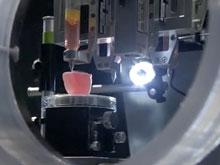
Surgeon Anthony Atala demonstrates an early-stage experiment that could someday solve the organ-donor problem: a 3D printer that uses living cells to output a transplantable kidney

7:24 – This is actually a desktop inkjet printer, but instead of using ink, we’re using cells. And you can actually see here the printhead going through and printing this structure, and it takes about 40 minutes to print this structure. And there’s a 3D elevator that then actually goes down one layer at a time each time the printhead goes through. And then finally you’re able to get that structure out. You can pop that structure out of the printer and implant it.

http://blog.sculpteo.com/2011/08/10/3d-printing-for-regenerative-medicine/

sexta-feira, 24 de junho de 2011

Vacina contra o Cancro?

Um Vírus com uma Livraria de DNA, que permite destruír uma data de Tumores diferentes, preservando o tecido são!
Se isto não é uma boa notícia, não sei o que seja!

New ‘gene therapy’ vaccine approach gives hope in fight against cancer
By Darren Quick
Using a virus containing a 'library' of DNA, researchers from the University of Leeds in the U.K., working with the Mayo Clinic in the U.S., have developed a vaccine that was able to destroy prostate cancer tumors in mice, while leaving healthy tissue untouched. Because the virus contains multiple fragments of genes, the vaccine is able to produce many possible antigens thereby boosting its effectiveness. The technique could be used to create vaccines to treat a wide range of cancers, including breast, pancreatic and lung tumors.

Previous 'gene therapy' vaccine have often delivered just one gene to stimulate the body's immune system to destroy cancer cells by producing a protein, called an antigen. This triggers the production of an antibody to kill or neutralize the antigen, but the development of successful cancer vaccines has proven difficult because each tumor has specific proteins and identifying the right antigen has been challenging. It was also feared that using several genes to increase the chances of producing successful antigens would produce an immune system response that would be too much for the body to handle.

quarta-feira, 15 de junho de 2011

Muitas e boas Notícias!

A Samsung adopta uma Tecnologia desenvolvida em Portugal!
Do Site chamado Boas Notícias:

Poderá ser o fim do velho silicío na construção dos ecrãs televisivos. Investigadores da Faculdade de Ciências e Tecnologia da Universidade Nova de Lisboa desenvolveram, em colaboração com a Samsung, uma nova geração de ecrãs que recorre a um novo novo tipo de transistores transparentes e mais baratos.

A novidade consiste na substituição do material semicondutor dos transístores, que é neste momento silício, por um novo material transparente à base de óxidos, como o óxido de zinco, e que oferece várias vantagens.

Este material - que tem já muitas aplicações como por exemplo nos cremes cicatrizantes e nos protetores solares - pode ser produzido a um custo muito mais baixo e à temperatura ambiente, disse esta semana à agência Lusa Elvira Fortunato, que coordena o projeto juntamente com o seu colega Rodrigo Martins.
http://www.boasnoticias.pt/noticias_Samsung-adota-tecnologia-made-in-Portugal_6894.html


Como construír um Dinossauro, a partir duma Galinha!

Video: How to Build a Dinosaur from a Chicken
By Clay Dillow

How does one build a dinosaur? There’s the much-celebrated Crichton/Spielberg method, in which you extract dino DNA from a preserved prehistoric mosquito. But there are problems with this approach, says paleontologist Jack Horner in a recent TED Talk, and besides: there are plenty of spare dinosaur parts laying around our modern world from which to build a dinosaur. We just need to find the right ones.

Horner has spent a career digging up some of the best-preserved biological artifacts leftover from the dinosaurs’ tenure on this planet, but in none of them, not even the soft tissues like preserved blood vessels, could he or his team find intact DNA--the kind you need to clone a dinosaur a la Jurassic Park. So he and some colleagues are looking for dino-era DNA in dinosaurs’ descendants: modern birds.
http://www.popsci.com/science/article/2011-06/video-how-build-dinosaur-chicken

...E aviões que vão ser autênticos Transatlânticos do Ar:


Video: Airbus Offers a Peek at the Translucent Future of Passenger Air Travel
By Clay Dillow
Airbus has seen the future, and it's spacious, sunlit and full of interactive screens. Oh, and cocktails will be served in the virtual bar, assuming someone isn’t playing 18 holes in there.

After revealing its larger vision of what aviation hardware will offer us in 2050 at last year’s Paris Air Show--reduced emissions, lower fuel consumption, reductions in noise and increases in speed--the company has turned its attention toward the passenger experience, offering a sneak peak of the future via the video below.

What does the future have in store? Well, assuming populations begin growing less obese and the economics of packing as many people on a flight as possible are discarded (in the future, air travel--like society--will know no class), the future is much more comfortable.
When flights are at less than full capacity, unneeded seats at the rear of the plane will collapse and all seats will redistribute themselves to offer everyone an equitable boost in legroom. These seats will also morph to fit passengers’ bodies.
http://www.popsci.com/technology/article/2011-06/video-airbus-offers-sneak-peek-future-passenger-air-travel

segunda-feira, 2 de maio de 2011

Micro-Robots ou Nano-Robots?


Herding Swarms of Microrobots
Tiny robots self-assemble with a single command.
By Kristina Grifantin
Imagine a swarm of microrobots—tiny devices a few hair widths across—swimming through your blood vessels and repairing damage, or zipping around in computer chips as a security lock, or quickly knitting together heart tissue. Researchers at the University of California, Berkeley, Dartmouth College, and Duke University have shown how to use a single electrical signal to command a group of microrobots to self-assemble into larger structures. The researchers hope to use this method to build biological tissues. But for microrobots to do anything like that, researchers must first figure out a good way to control them.

"When things are very small, they tend to stick together," says Jason Gorman, a robotics researcher in the Intelligent Systems Division at NIST who co-organizes an annual microrobotics competition that draws groups from around the world. "A lot of the locomotion methods that have been developed are focused on overcoming or leveraging this adhesion."


http://www.technologyreview.com/computing/37482/?p1=A1&a=f

terça-feira, 28 de setembro de 2010

Novidades

A Universidade de Arizona revela-nos uma prometedora maneira de aproveitar calor como nunca antes, de calor directamente para a corrente eléctrica, E... Com 100 vezes mais rendimento:

Turning Waste Heat Into Power

UA physicists have discovered a new way of harvesting waste heat and turning it into electrical power. Taking advantage of quantum effects, the technology holds great promise for making cars, power plants, factories and solar panels more efficient.

What do a car engine, a power plant, a factory and a solar panel have in common? They all generate heat – a lot of which is wasted.
University of Arizona physicists have discovered a new way of harvesting waste heat and turning it into electrical power.

Espuma de Titânio para reparar e/ou substituír ossos:

Titanium foams replace injured bones

Flexible yet rigid like a human bone, and immediately capable of bearing loads: A new kind of implant, made of titanium foam, resembles the inside of a bone in terms of its structural configuration. Not only does this make it less stiff than conventional massive implants. It also promotes ingrowth into surrounding bones. 
The greater one‘s responsibilities, the more a person grows. The same principle applies to the human bone: The greater the forces it bears, the thicker the tissue it develops. Those parts of the human skeleton subject to lesser strains tend to have lesser bone density. The force of stress stimulates the growth of the matrix. Medical professionals will soon be able to utilize this effect more efficiently, so that implants bond to their patients‘ bones on more sustained and stable basis.


...E Turismo no Espaço!

Virgin to launch space tourism in 18 months
 

AFP - Billionaire entrepreneur Richard Branson said Monday that Virgin Galactic is on track to offer commercial space travel within 18 months, and that space hotels are next on the drawing board.
The project's SpaceshipTwo, an aircraft built by aviation engineer Burt Rutan and designed to carry paying customers into suborbital space, had its maiden flight in the California desert in March.
"We just finished building SpaceShipTwo. We are 18 months away from taking people into space," Branson told a business conference in Kuala Lumpur, adding that the fare will start at 200,000 dollars.
Virgin Galactic, which aims to become the world's first commercial company to promote space tourism, has already collected 45 million dollars in deposits from more than 330 people who have reserved seats aboard the six-person craft.
 http://www.france24.com/en/20100927-virgin-launch-space-tourism-18-months

quarta-feira, 16 de junho de 2010

Noticias incríveis!

Como voltar à vida, depois de Congelar:

Yeast and worms can survive hypothermia if they are first subjected to extreme oxygen deprivation, a new study finds.
The results could explain a long-held mystery as to how humans can be brought back to life after "freezing to death," the scientists say.
The study uncovered a previously unknown ability of organisms to survive lethal cold by temporarily slowing the biological processes that maintain life. 

"We have found that extension of survival limits in the cold is possible if oxygen consumption is first diminished," said researcher Mark B. Roth of Fred Hutchinson Cancer Research Center in Seattle, Wash.
One form of "forced hibernation," the behavior known as "suspended animation," literally involves the sudden halting of chemical reactions in the body due to the lack of oxygen. A 10-hour time lapse video of a garden worm embryo in the process of developing into a full-fledged baby worm showed a rapid process of cell division freeze to a stop upon the environment’s oxygen removal. That same cell division resumed unaffected two and a half hours after oxygen was restored.

http://www.livescience.com/health/cold-freezing-oxygen-deprivation-100611.html

...E ver a Erva a crescer!

Video: Scientists Watch Grass Grow, at the Cellular Scale

By Rebecca Boyle Posted 06.14.2010 at 4:44 pm
A. thaliana cell development A new video animation shows cellular development in Arabidopsis thaliana, shedding light on how plants grow. Nature Methods via Scientific American
Watching grass grow is way more interesting than you think. In an effort to understand cellular development in plants, a team of French scientists made a surprisingly exciting video animation of grass growing at the cellular scale.
The team stained growth cells in Arabadopsis thaliana and rice plants, and trained laser-scanning microscopes on the growing plants, according to Scientific American. They fed the microscope data into new computer algorithms that reassembled the structures, cell by cell, in three dimensions. The result is this video.


E a Microsoft criou uma TV em 3D, SEM os Óculos 3D do costume:
Hummm... Microsoft... Irá estar sempre a CRASHAR?
Microsoft's New Lens Promises 3-D TVs Sans Glasses
By Corinne Iozzio Posted 06.11.2010 at 12:43 pm 10 Comments

Everyone's got World Cup Fever this weekend, and for a lucky few that means getting the chance to break in their brand-spankin'-new 3-D TVs as the matches are broadcast from South Africa. For those who haven't taken the 3-D plunge yet -- be it because of prohibitive pricing or not wanting to deal with the dorky glasses -- Microsoft's Applied Sciences group has shared a new glasses-less 3-D display that could herald the adoption of the sets at long last.
http://www.popsci.com/technology/article/2010-06/microsofts-new-lens-promises-3-d-sans-glasses


...MARAVILHA, este drone para o Povo:

How does it work?

First quadricopter that can be controlled by an iPhone/iPod Touch/iPad

Thanks to its on-board Wi-Fi system, you can control the Parrot AR.Drone using an iPhone®, iPod Touch®, or an iPad®. It was initially designed for the Apple platforms and will be also available on other platforms in the next few months.

http://ardrone.parrot.com/parrot-ar-drone/en/how-does-it-work

Mais um?
'Tá bem!
Que tal um novo Metamaterial que vai fazer este Avião, Indetectável?
A New Engineered Stealth Metamaterial is the Blackest Ever
By Rebecca Boyle
Stealth Metamaterials A B-2 Spirit bomber flying over Guam. A team of researchers from Purdue University and Norfolk State University in Virginia designed a new metamaterial that absorbs almost all the light that hits it, heralding a new wave of stealth technology. Wikimedia commons/US Air Force
A new blacker-than-black metamaterial absorbs almost all the light that hits it, heralding a new breed of stealth technology.
The material's internal structure absorbs almost all the electromagnetic radiation in a particular range, New Scientist reports. Ordinary black objects, by contrast, always reflect a bit of light. The material could be applied to all parts of the electromagnetic spectrum, meaning it could be used to make materials invisible to radar.
Designed by Evgenii Narimanov of Purdue University, Mikhail Noginov of Norfolk State University in Virginia and their colleagues, the material consists of silver nanowires embedded in very thin 0.4-inch aluminum oxide squares. Their array-like structure gives them their unusual properties, New Scientist says.

Man-made metamaterials can also bend light to create invisibility cloaks, ultra-thin sound-proof walls and even miniature Big Bangs and megaverses.

The researchers tested their new black material with near-infrared radiation, just beyond the red end of the visible spectrum. When the radiation hit the polished material at less than 45 degrees from perpendicular, about 20 percent of the radiation bounced off. When they roughened the material so it wasn't smooth, less than 1 percent of the radiation bounced off.

Narimanov told New Scientist the technology would likely be used to build radar-proof stealth equipment.
http://www.livescience.com/environment/airplanes-punch-holes-in-clouds-create-rain-100614.html

...E para acabar, NAS NÚVENS:

Wow! Jets Punch Holes in Clouds and Create Rain
By LiveScience Staff
posted: 14 June 2010 12:21 pm ET
Aircraft can accidentally punch holes in clouds, leaving a trail of snow or rain in their wake, a new study finds.

Turboprop and jet aircraft that climb or descend under certain atmospheric conditions can inadvertently trigger what's known as cloud seeding. This technology is usually associated with schemes to control the weather. However, cloud seeding can happen by accident as planes soaring through mid-level clouds leave behind odd-shaped holes or channels in the clouds and cause narrow bands of snow or rain to develop and fall to the ground.

Holes punched in clouds are a phenomenon that has been recognized for many years and seen in photos from around the world. A front-page feature on Yahoo! carried the headline "A Halo over Moscow" after photos emerged of just such a hole in October 2009.

The secret behind these mysterious clouds has now been revealed: Supercooled water droplets that remain liquid even at subfreezing temperatures — below about 5 degrees Fahrenheit (minus 15 degrees Celsius). When an airplane cuts through clouds containing the supercooled water droplets, air is cooled behind aircraft propellers or over jet wings, and these water droplets freeze and drop toward Earth.
http://www.livescience.com/environment/airplanes-punch-holes-in-clouds-create-rain-100614.html


terça-feira, 15 de junho de 2010

Notícias

Dispersar o Calor como nunca antes, com Nanoestruturas:

Nanostructure coatings remove heat four times faster

In a finding that could well revolutionize cooling technology as we know it, researchers at Oregon State University and the Pacific Northwest National Laboratory have discovered a way to achieve near-optimal heat dissipation by applying a nanostructured coating. Because of performance, versatility and economy of materials used, their method could soon lead to better electronics, heating and air conditioning.
We've recently discussed the importance of heat dissipation in electronics; however, while cooling laptops and the likes is an important issue in itself, they are by no means the only area that could benefit from better heat dissipation. The team's work focuses on heat transfer using water in particular and could be used in heating, cooling and air conditioning applications as well as keeping your lap from burning up the next time you check your email at the airport.

http://www.gizmag.com/nanostructure-coatings-remove-heat-four-times-faster/15384/
Fungos, para criar Bio-Combustível:

Fungus Among Us Could Become Non-Food Source For Biodiesel Production
by Staff Writers
Murcia, Spain (SPX) Jun 11, 2010
In the quest for alternatives to soybeans, palm, and other edible oilseed plants as sources for biodiesel production, enter an unlikely new candidate: A fungus, or mold, that produces and socks away large amounts of oils that are suitable for low-cost, eco-friendly biodiesel. That's the topic of a study in ACS' bi-monthly journal Energy and Fuels.

Victoriano Garre and colleagues point out that manufacturers usually produce biodiesel fuel from plant oils - such as rapeseed, palm, and soy. However, expanded production from those sources could foster shortages that mean rising food prices.

In addition, oilseeds require scare farmland, and costly fertilizers and pesticides. To meet growing demand for biodiesel fuel, scientists are looking for oil sources other than plants. Microorganisms such as fungi, which take little space to grow, are ideal candidates. But scientists first must find fungi that produce larger amounts of oil.
http://www.biofueldaily.com/reports/Fungus_Among_Us_Could_Become_Non_Food_Source_For_Biodiesel_Production_999.html

quarta-feira, 2 de junho de 2010

Notícias

Células de Retina, criadas a partir de Células estaminais:

In another world first in the fight against degenerative eye disorders, scientists from the Universtiy of California, Irvine, have created an eight-layer early-stage retina from human embryonic stem cells. Not only is this the world's first three-dimensional complex tissue structure to be made from stem cells, but it also marks the first step toward the development of transplant-ready retinas to treat eye disorders affecting millions.
The retina is the part of the eye that records images and sends them from the eye to the brain via the optic nerve. Building on a process designed in a previous study, researchers created multiple cell types using microscopic gradients for solutions in which to bathe the stem cells and initiate specific differentiation paths.

Uma maneira simples de constuír órgãos em Laboratório, como se as Células fossem Legos!

Earlier this year we looked at a technique to grow 3D cell cultures using magnetic forces to levitate cells while they divided and grew, forming tissues that more closely resemble those inside the human body. Now researchers at the MIT-Harvard Division of Health Sciences and Technology (HST) have devised a new way to achieve the same goal by using "biological Legos".
Tissue engineering has long held promise for building new organs to replace damaged ones, like livers, or blood vessels and other body parts. However, one major obstacle is getting cells grown in a lab dish to form 3D shapes instead of flat layers. To overcome this problem the researchers have encapsulated living cells in cubes and arranged them into 3D structures, just as a child would construct buildings out of blocks.
http://www.gizmag.com/artificial-organs-biological-legos/15127/

...E um Helicóptero que ultrapassa os 208 Km/h!
Sikorsky Aircraft’s goal of producing the fastest helicopter ever built has taken another step towards becoming a reality. Its coaxial X2 Technology demonstrator has achieved a speed of 181 knots (208 mph) in a test flight – faster than the 160-170 knot speeds generally possible with conventional helicopters and edging closer to the eventual aim of delivering 250 knot (288 mph) cruising speeds.
As we’ve reported previously, the X2 demonstrator combines an integrated suite of technologies intended to advance the state-of-the-art, counter-rotating coaxial rotor helicopter. These include fly-by-wire flight controls, counter-rotating rigid rotor blades, hub drag reduction, active vibration control and an integrated auxiliary propulsion system.
After the latest test flight Jim Kaglis, Program Manager, Sikorsky Advanced Programs for Sikorsky, said, “the X2 Technology demonstrator today exceeded average helicopter speeds of a conventional helicopter, generally 160-170 knots.”

http://www.gizmag.com/sikorsky-x2-demonstrator-181-knots/15277/