Blog Posts

Mostrar mensagens com a etiqueta MIT. Mostrar todas as mensagens

quarta-feira, 26 de agosto de 2015

MAKERBLOCK! E o PulleyBot, poupar na Impressão 3D, e imprimir em 10 Materiais simultâneamente!

Podia só dar esta Notícia, hoje, e dava-me por satisfeito, isto é uma Ferramenta que faltava ao Inventor, ao Modelista e ao Engenhocas em geral.
Junte-se o Arduino a um Sistema de Construcção dedicado ao Automatismo e à Robótica, e teremos muita gente feliz... 
E vem com Instrucções, e tudo!
FANTÁSTICO!
Vejam a análise dum Kit, por estes Bacanos:


Makeblock, robots con Arduino al alcance de todos: Análisis

En Xataka Smart Home sabemos que os encantan las entradas dedicadas a la automatización. Hace tiempo nos contactaron de Makeblock para ofrecernos un Starter Robot Kit V2.0 para su revisión, y aquí os traemos la primera parte de nuestro análisis, en la que nos centraremos en la descripción del kit y el montaje de uno de los modelos básicos para comprobar que todo funciona y familiarizarnos con el conjunto.
En concreto vamos a construir un agente autónomo que se desplaza con un par de orugas y que cuenta con un sensor de ultrasonidos para evitar obstáculos y un sensor de infrarrojos para poder controlarlo a distancia. Y todo ello con una placa de control Arduino Leonardo que ya tiene todo lo necesario para que la construcción sea coser y cantar.
Makeblock es un sistema de construcción de elementos basado en Arduino, con elementos tales como actuadores, motores, interruptores y hasta controladoras bluetooth. Todos estos módulos electrónicos son de código abierto. Cualquiera puede descargarse las librerías CAD o esquemas que los forman. http://blog.makeblock.cc/makeblock-robots-con-arduino-al-alcance-de-todos-analisis/


Mas para que se lembrem que às vezes, o mais simples resolve melhor, eis um Robot que funciona por simples sistemas mecânicos:


PulleyBot: A Pulley Driven Robot
printeraction 
The PulleyBot is a simple, single actuator 3D printed toy with a transmission entirely made up of pulley systems. This instructable is a tutorial on how to assemble the PulleyBot, but if you are interested in pulley, cable, and chain mechanisms, then I would suggest checking out this Pulley Mechanisms Instructable. I hope you have fun building this, and even more fun designing your own!The PulleyBot is a simple, single actuator 3D printed toy with a transmission entirely made up of pulley systems. This instructable is a tutorial on how to assemble the PulleyBot, but if you are interested in pulley, cable, and chain mechanisms, then I would suggest checking out this Pulley Mechanisms Instructable. I hope you have fun building this, and even more fun designing your own!

http://www.instructables.com/id/PulleyBot-An-Pulley-Driven-Robot/


Já mandaram imprimir um Objecto vosso, e custa uma Fortuna?
Eu, já!
Pois aprendam estas dicas, simples, DEPOIS de se descobrirem, de como reduzir dramáticamente os custos, ao som de, até 70% de Poupança!
É bom!


Cheaper 3D Prints
markk7 
Have you ever uploaded a 3D design and been shocked at the high cost of production? Well I just spent the last few months getting one rude shock after another from various printing services. But I learned a few things the hard way during the process.
Getting your prints manufactured in laser-sintered nylon has a lot of advantages over printing at home. But for the first few weeks (okay, months) I was very confused. Two similar prints could vary in cost from $5 to $50. I tried making walls thinner because I thought all the costs were based on the amount of material used. Slowly I started understanding where a lot of the hidden costs were, and how to eliminate them to lower my prices
These tips are going to seem laughably simple to an experienced designer, but by using these very basic tips I reduced my average print-cost by over 70 percent since my first attempts at 3D printing through a service provider. For example, one of my very first designs dropped from $38 per print to less than $5, with no loss in quality... so I'm sharing the lessons learned. 
http://www.instructables.com/id/Cheaper-3D-Prints/


...E se imprimir Objectos para vocês, soa a Música para os vossos Ouvidos, cá vai Orquestra, obra do MIT, nada menos de 10 Materiais, sim, 10 Materiais diferentes, usados numa só Impressão!
E imprime sobre Objectos já existentes, e resulta pouco mais caro que os tradicionais Makerbots...


MIT'S NEW 3D PRINTER CAN PRINT 10 MATERIALS SIMULTANEOUSLYKelsey D. Atherton
Right now, the typical 3D printer is a tool for making plastic objects. Assembling them in layers according to a pre-programmed plan, the printers can quickly make weirdly shaped parts, but they’re often limited to working with just one material at a time. Additive manufacturing, as 3D printing is also known, offers so much more. A new printer, created by MIT’s Computer Science and Artificial Intelligence Laboratory (CSAIL), can print up to 10 materials into a single object —and incorporate other, finished parts directly into the design— all at a fraction of the cost of complex industrial 3D printers
Their new printer, known as the MultiFab, is a system of systems. A central computer runs the printing program, but as it does so it receives feedback from 3D scanners and machine vision, which map the object as it’s being made, allowing the computer to adjust the printing process and materials accordingly.
http://www.popsci.com/mit-multifab-printer-prints-10-materials-simultaneously?dom=tw&src=SOC


quinta-feira, 26 de março de 2015

Flexures!

Não há maneira de se exagerar a importância DESTA Lição do Grande Mestr, Dan Gelbart, o que isto abre de possibilidades para o Corte Laser CNC é incrível, imagines, máquinas de uma peça só e fazer do Acrílico, material de Mola!

Nem cá ponho mais do que estas Fontes de Sabedoria, para que vocês se CONCENTEM só nesta Matéria fenomenal...

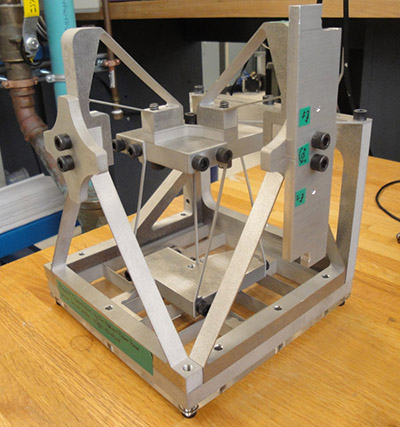
Vejam só esta imagem!


Uma máquina de 1 SÓ PEÇA, com 2 Alavancas, e Molas Lineares!


Building Prototypes Dan Gelbart part 10 of 18 Flexures


Mas tem ainda mais, pessoal das Engenhocas e Fabbers, uma Lição completa do MIT...
Sobre o mesmo assunto, mais aprofundado!


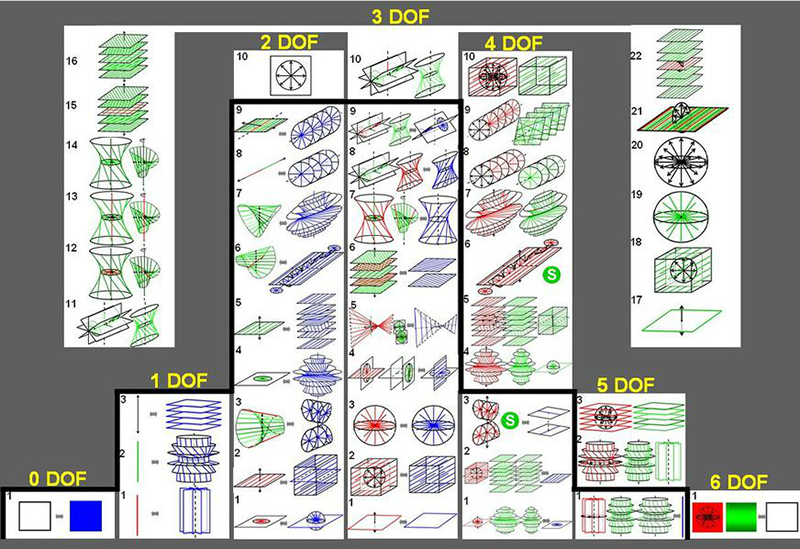
Flexures

© Marcel Thomas

1 Introduction
Flexures are bearings that allow motion by bending load elements such as beams. The arrangment of beams can be designed to be compliant in its degree(s) of freedom (DOF), but relatively stiff in its degree(s) of constraint (DOC). This allows engineers to provide motion in desired directions, but constraint in other directions. Flexures are important for engineers because they allow stiction-less, controlled, limited-range motion. These well-designed, well-understood springs can then be implemented in precision machines to allow the development of medical devices and machines for electronic fabrication. This entry is about understanding the most important parameters for flexure design. The functional requirements for flexures include (but are not limited to): desired kinematics, range of motion, stiffness, load capacity, repeatability, mode shapes/frequencies, and an error budget.
Designing flexures involves developing a model, using FEA, and experimentally verifying the models. There should be a pencil-and-paper approximation that allows you to see which variables are most important and it gets you in the ballpark of the correct dimensions. In other words, the model shows you which direction to go and by how much. How short can I make this beam so that it can be at 30% of the yield stress? The model should answer questions like that, keeping real-world constraints in mind.
By carefully applying these equations to your system, you should have a decent approximation for its behavior. Once the equations are developed, you should put these variables in a MATLAB script or an Excel spreadsheet. That way, you can change one variable at a time and see how that affects the entire system. Flexures are typically modeled using FEA, which is the subject of another entry.


sexta-feira, 3 de agosto de 2012

Processing, no Raspberry, e outra Impressora 3D portátil...

Atenção, não estou a falar Portinglês, Processing é uma Linguagem de programação, que se pode usar no Raspi!
Mais um Artigo impecável do Designspark...

Processing on the Raspberry Pi

A look at getting the Processing programming language and IDE up and running on a Raspberry Pi, and example code working with the TI Chronos eZ430 development kit.
Processing is a programming language that is targeted at “non-programmers” and with a particular focus on artists and designers. But the Processing syntax and IDE will be familiar to many more as they form the basis of the Arduino development environment, and Processing applications are similarly referred to as “sketches”.
Built on top of the Java programming language, Processing provides a much simplified syntax and graphics programming model. And as with Arduino development it can be extended via libraries that make easy work of more advanced things like network programming.
 http://www.designspark.com/content/processing-raspberry-pi


Mais outra, que tal os Jogos Electrónicos, como os que se jogavam, e ainda jogam, nos Cafés, mas no Raspi?


Raspberry Pi Arcade

I grew up in the dawn of arcade games, and living at the coast meant that I had access to a couple of decent arcades where I could play all the classics as they came out - Space Invaders, Galaxian, Defender, Moon Cresta, Galaga, Phoenix, Star Wars, Tron and Tempest all stick in my mind, but Mr Do! and Bubble Bobble were my all time favourites.

The Multiple Arcade Machine Emulator (MAME) has been around for years now, and has found its way into all sorts of places (a version was even available in the Apple Appstore just before last Christmas just in time for me to get an iCade). Of course the Raspberry Pi is quite capable of running many of the older games, which should include all the true classics. In this post I'm going to run through how I got MAME going on my RPi.


E já vimos isto, mas cá vai mais outra Impressora 3D de Viagem, numa Mala e tudo!


MIT students reveal PopFab, a 3D printer that fits inside a briefcase

By Jonathan Fincher
 There are plenty of different 3D printers to choose from these days, from the popular Makerbot Thing-O-Matic to the budget-priced Solidoodle. These all have one drawback however in that they aren't exactly portable. Most need to be disassembled to be moved and even the fully-assembled Cubify printer isn't really built for travel. But now, two MIT students have developed the PopFab, a machine that does 3D printing and more, all while fitting inside a small suitcase.
The PopFab was developed by students Ilan Moyer and Nadya Peek, from the MIT CADLab and MIT Center for Bits and Atoms respectively. Billed as a "portable fabrication multi-tool," the machine was revealed through an online video showing the whole device folding out from a metal briefcase and almost immediately printing a small object after a bit of setup. All it takes is to attach the printing head to the fold-out arm, feed in some printing material, and connect a computer to transmit a design.

segunda-feira, 30 de abril de 2012

Lego às carradas!

É pó Menino e pá Menina, e para uns Passarões que ainda hoje, gostam de Lego: 

Lego e mais Lego no Campo Pequeno

por Elisabete Silva

Ao entrar, o difícil é decidir por onde começar. Três milhões de peças de Lego compõem cidades, monumentos, naves espaciais, comboios... É a maior exposição em Lisboa do género que promete atrair crianças e adultos.  

O T-Rex tenta dominar a praça do Campo Pequeno, mas o seu tamanho rivaliza com o tigre, o urso ou o camelo (que pesa 500 quilos). São sucesso garantido por serem vistosos, mas é nos pormenores que está o mais apetecido na exposição que hoje abriu portas.
Na cidade espacial nada falta. Naves, comboios, radares, com direito a movimento para dar mais realismo. Mas numa cidade mais "real", também é impossível não se ficar perdido em tanto pormenor, cada um correspondente a horas e horas de trabalho.

http://www.dn.pt/inicio/artes/interior.aspx?content_id=2446602


Continuando na pura Diversão, Estudantes do MIT transformaram um Prédio, num jogo de Tétris!
C'um caneco!


MIT students turn whole building into huge game of Tetris 
By Paul Ridden
 The two-hundred and ninety-five feet (ninety meter) tall Building 54 on MIT's Cambridge campus has become the canvas for a number of carefully planned and daringly executed visual displays over the years, not strictly allowed by the administration but often looked upon with some appreciation. The building is home to the Institute's Department of Earth, Atmospheric, and Planetary Science (EAPS) and has a host of meteorological instruments and radio communications equipment on its roof - but its the grid-like windows to the front that have become the main attraction to hackers, as they are known. The latest hack is the successful realization of a long-standing challenge, a huge playable game of Tetris.


...E que tal fazerem a vossa própria Máquina CNC?


Make Your Own DIY CNC

This instructable outlines the assembly process of my 2nd generation CNC machine which I designed to be simple to build and quiet enough to be apartment friendly. I have included example projects that I have made in the first two weeks of using the machine to demonstrate its capabilities.

This is the second CNC machine that I have designed and built. My first machine was based off of
oomlout’s instructable “How to make a Three Axis CNC Machine (Cheaply and Easily)” (by far my favorite instructable and the one that got me hooked on the site). It was moderately successful, cutting a number of parts from foam (a summary of parts made can be found on my abandoned blog here along with some build photos). The lack of overall stiffness and play in the linear mechanisms meant that plywood and plastics could not be cut effectively. The biggest downfall of the machine was the difficulty to setup and square the axes and lacked the ability to make fine adjustments once set up. The drive pulleys were sandwiched between the gantry sides and if a pulley loosened the entire gantry structure had to be disassembled and put back together and squared all over again (a couple evenings of work).

http://www.instructables.com/id/Make-Your-Own-DIY-CNC/


Uma grande notícia da malta do Arduíno, mais específicamente o Daniel Berenguer estas Miniaturas Wireless, vão dar para realizar muita ideia...

panStamp - Wireless Arduino-compatible miniatures

Dear group members, we are in the process of releasing our new low-power wireless pansTamps. These modules are programmable from the Arduino IDE. Availability of libraries, stack, Python tools and a web-based automation platform called Lagarto. Simple and rapid upload of values to the cloud (Pachube, ThinkSpeak and open.sen.se). We're also running a campaign on Indiegogo in order to get funds for the project:
http://igg.me/p/89807?a=531961


sexta-feira, 30 de março de 2012

Electrónica em Blocos, gasolina eléctrica, e Aço Plástico

Através da nossa amiga Catarina Mota, vem-nos esta Óptima ideia, LittleBits!


Ayah Bdeir: Building blocks that blink, beep and teach
TED Talks
Imagine a set of electronics as easy to play with as Legos. TED Fellow Ayah Bdeir introduces littleBits, a set of simple, interchangeable blocks that make programming as simple and important...


Porque os "carros eléctricos" são, sinceramente, uma anedota, e iriam arruinar as já sobrecarregadas e sobre-reguladas Redes Eléctricas, eis algo de REALMENTE positivo, um Combustível Líquido, a partir de Energia Solar, sem ter de roubar Alimento às populações, como o Bio-Etanol...


Researchers generate liquid fuel using electricity

By Darren Quick

While electric vehicles have come a long way in the past decade, they still have many disadvantages when compared to internal combustion engine-driven vehicles. The lithium-ion batteries that power electric vehicles have a much lower energy storage density when compared to liquid fuel, they take longer to “refuel,” and they lack the supporting infrastructure that has built up around conventional vehicles over the past century. Now researchers at the UCLA Henry Samueli School of Engineering and Applied Science have developed a process that could allow liquid fuel to be produced using solar generated electricity.
Using only electricity for the energy input, the team was able to convert carbon dioxide into the liquid fuel isobutanol. They did this by genetically engineering a lithoautotrophic microorganism (one that utilizes inorganic compounds as energy sources) known as Ralstonia eutropha H16 to produce 3-methyl-1-butanol and isobutanol, a colorless, flammable liquid that holds potential as an alternative to gasoline in combustion engines. The microorganism was placed in an electro-bioreactor and used only carbon dioxide as the carbon source and electricity as the sole energy input.


Eis algo de fantástico, um Novo Material que pode substituír o Aço, 30% mais leve, e é um Material fácilmente moldável:


Polyurethane composite could replace steel or aluminum in some applications

By Ben Coxworth

A consortium of German research groups has created a new sandwich-type material that they claim offers strength similar to that of steel or aluminum, yet is significantly lighter and less expensive. It consists of a honeycomb-structured paper core, with glass fiber-reinforced layers of polyurethane on the outsides. To give an idea of how tough it is, it’s about to be tested on the diesel engine housing of a train.
The material is intended for a number of applications, but it was decided that the engine housing would be a good test. The housing will be located on the underside of the train, where it will be constantly subjected to track debris such as flying rocks. It must also contain engine fluids such as oil, to keep them from leaking into the environment, while additionally serving to contain the flames in the event of an engine fire – additives in the polyurethane ensure that it meets fire safety standards.


...E esta pequena maravilha, com muitas aplicações, mas dá um Brinquedo do caraças...


Collapsible “Buckliball” turns failure into functionality

By David Szondy

Taking inspiration from a toy, a team of researchers at MIT have developed a new engineering structure that is mechanically unstable, yet collapses in a way that is predictable and reversible. The structure, formed out of a single piece of rubber-like material, is fabricated so that it collapses in harmony to form a smaller structure that can then be expanded into the original shape. This structure opens up new potentials in everything from architecture to micro-medical applications.

When we think of structures, we tend to think of them as things that don’t fall down. If you had to come up with one common criterion for bridges, buildings, houses, stadiums, sheds and dog houses, it’s that once built, they should tend to stay upright and not come crashing down around people’s ears. If they do so, that is generally regarded as a failure, so engineers put a great deal of effort into keeping that from happening.

terça-feira, 20 de março de 2012

RazorLabs com desconto, MIT com um Concurso, e Sculpteo 3D Printing Cloud Engine!

Os nossos amigos da Razoelabs estão a fazer mais um Desconto, 20% em todas as Encomendas, lembrem-se foi assim que eu mandei cortar a ElastomatiK lá:


Hello there RazorLABbers!
Today is the first day of spring, time to shake off those winter blues and get making!

It's nearly Easter time, the time to over indulge, and we thought we would spoil you with a treat of our own - 20% off all orders until midnight 9th April! Use this coupon code: ZLHESS to redeem your Easter treat and spend your holidays assembling your latest project. Spread the springtime joy and share with your friends!

For all the students out there, spring is also the time to start knuckling down and the hard work begins. We know it's a tough time and we want to help ease the pressure so we offer all students a 10% discount on their orders. To take advantage of the offer use coupon code: YCHPEO (expires 31/12/12). Share with your class mates, and if you're not a student yourself, perhaps you know someone who is? Son, Daughter, brother, sister, cousin, neighbour...


O MIT em Portugal tem de novo o Concurso "Buiding Global Innovators", para criar Inovadores a nível Global:


Building Global Innovators is back!

3rd Edition is open - submit your application here.
Deadline: 1st May
 
Here's a few numbers from our track record:
  • 80% of the promoters succed in launching a start-up
  • 69% raised funding, of which over 60% is from Venture Capital sources
  • 50% of the start-ups doubled their teams, creating 35 new jobs
3-step rule to preparing a winning submission:
  1. Read Rules & Regulations
  2. Get inspired by previous year's Award winners (1st Ed, 2nd Ed.)
  3. Then prepare and send us your submission
Beeing one of the 20 selected teams really depends on your effort
 http://mitportugal-iei.org/


E Retalhistas, eis uma maneira de personalizarem os vossos Produtos, através da Sculpteo:


So You Are Thinking About Integrating the Sculpteo 3D Printing Cloud Engine Into Your Store?

quarta-feira, 13 de julho de 2011

Mais coisas boas

O MIT não pára, notícia cortesia da Ponoko, eis Painéis Solares feitos por impressão em papel:


MIT unveils Solar cells that can be 3D printed on ordinary paper, plastic or fabric
The new printing process uses vapors, not liquids, and temperatures less than 120 degrees Celsius. These “gentle” conditions make it possible to use ordinary untreated paper, cloth or plastic as the substrate on which the solar cells can be printed.

In order to create an array of photovoltaic cells on the paper, five layers of material need to be deposited onto the same sheet of paper in successive passes, using a mask (also made of paper) to form the patterns of cells on the surface. And the process has to take place in a vacuum chamber.


Uma pequena maravilha, notícia na Ponoko!!!


The teeniest cabinet
Pushing pixels on a scale that makes the Nanocade look positively giant, this miniature Space Invaders arcade cabinet faithfully reproduces that classic retro gaming feel down to the smallest details.

Constructed from 6mm MDF, the unit houses a modded Game Boy Advance SP and features a tiny joystick alongside arcade-style buttons sourced from eBay. The GBA innards are accessible through a magnetically attached rear panel, so that cartridges can be swapped out for some gaming variety if those Invaders get too much for you.

Click through to see some gameplay action in a video where Victor, the man behind it all, talks through a few of the quirks of his miniature construction.


Uma câmara de Visão Nocturna:

http://www.instructables.com/id/Night-Vision-Camera-1/


Uma loucura sem riscos, uma Bazuca com um Aspirador, e pouco mais:


http://www.instructables.com/id/Make-a-Vacuum-cleaner-Bazooka/


Mais uma, que a Ponoko está sempre a bombar, neste concurso fiquei a saber do Site Lynda.com, que é fantástico: Um Site com Cursos para aprender uma data de Software!

This month the Ponoko blog is partnering with lynda.com to give 5 winners a free, 1 month premium subscription to the lynda.com Online Training Library.

If you’re not familiar with lynda.com, its a virtual mecca for online learning of software. They’ve got top-notch courses — uncountable hours really — of video training on a 100 different softwares.

Course subjects include 3D, Animation, Audio, Business, Design, Development, Home Computing, Photography, Video, Web + Interactive.

But we think all you makers out there will really like the 3D & Design stuff.

There are courses on 3ds Max, AutoCAD, Blender, CorelDRAW, Freehand, SketchUp, Illustrator, Maya, Rhino, ZBrush and more.

http://blog.ponoko.com/2011/07/11/win-a-1-month-premium-subscription-to-the-lynda-com-software-online-training-library

terça-feira, 7 de junho de 2011

Novidades

Um casco aquecido faz o barco andar mais depressa!

Hot hulls might mean slipperier ships 

By Ben Coxworth

Want to make a ship move faster through the water? Well, one thing that you can do is paint its hull with low-friction or anti-biofouling paint, to keep barnacles and other marine organisms from growing on it. According to Prof. Derek Chan, from the University of Melbourne's Department of Mathematics and Statistics, another approach that should work is to heat that hull up to a temperature of over 100C (212F). His proposed method is based on a 255 year-old principle known as the Leidenfrost effect.

Named for its discoverer, German doctor Johann Gottlob Leidenfrost, the Leidenfrost effect is the phenomenon wherein a liquid, when exposed to a solid that is significantly above that liquid's boiling point, forms an insulating vapor layer between itself and that solid. This is the reason that water droplets dance across a sufficiently-hot skillet, instead of just evaporating on the spot.


... Os futuros Aviões Não-Tripulados vão voar como os outros, mas poderão também bater asas!


Variable-wing prototype points to the future of UAVs


By Noel McKeegan
The role of unmanned aerial vehicles (UAVs) has expanded rapidly in both military and civilian circles over the past decade and although most designs to date are miniature versions of conventional aircraft, we can expect to see much more radical examples emerge in the near future. In developing this next-generation of UAVs engineers are looking to go beyond the limitations of fixed wing and rotary wing aircraft and to do it, they are turning to nature's ultimate flying machines - birds. We've already seen seen flapping-wing micro-aircraft, robotic seagulls and even a design based on a pterodactyl. Engineers at UC San Diego are furthering this approach with research into variable-wing techniques that could result in a bird-like UAV capable of spot landing.

The ultimate goal of the UC researchers is to create a UAV that can both cruise efficiently like a fixed wing aircraft and land on a perch. To achieve this they are studying the wing morphing and flapping techniques used by birds.


E um Foguetão feito por particulares foi lançado, com sucesso parcial...

Homebuilt $70,000 single-person spacecraft tested

By Pawel Piejko

Sending a man to outer space in a homebuilt spacecraft worth US$70,000 may seem like a crazy idea to most of us, but not for a Danish group of enthusiasts who call themselves Copenhagen Suborbitals. Their shoestring-budget single-person flying bullet might have come one step closer to an actual manned flight, thanks to a partially successful test flight last Friday (June 3).

The amateur space engineers prepared everything just as if it was going to be a real flight to space, apart from the passenger, which actually was a crash-test dummy. The rocket HEAT 1-X was launched from a floating ramp called "Sputnik" on the Baltic Sea, carrying a single-person standing capsule known as Tycho Brache (named after a Danish astronomer).
(Sinceramente, se fosse um Potuguês ou um Brasileiro a fazer isto, eram uns maluquinhos, és loirinho e tens olhos azuis, é "aventureiro")...

sexta-feira, 15 de outubro de 2010

MIT, é muito bom!

MIT, é muito bom!
Vejam só esta página, para quem quer  aprender a mexer num Engenho...

E tem secções para toda a Oficina, Torno, trabalhar Chapa , etc.

O texto está cheio de Links com Vídeos explicativos, é só carregar, e ver!

Por exemplo o Link Hand feed vai-vos mostrar isto:

Não há que falhar.


Vão lá ter, e atenção ao Índice, à esquerda:
http://electron.mit.edu/~gsteele/mirrors/www.nmis.org/EducationTraining/machineshop/lathe/intro.html