
Blog Posts

Mostrar mensagens com a etiqueta metamateriais. Mostrar todas as mensagens

sexta-feira, 7 de outubro de 2016

Uma Máquina duma peça só! E uma máquina de jogos de garra, um Catamaran de Espuma de Nylon, um Quadracóptero de PVC, e o Sketchup paramétrico.

Como já referi antes, sobre Fixtures, a Ponoko oferece-nos esta dica, da Revista dezeen, aqui, chamam-lhes Metamateriais, mas parece-me a mesma coisa.
De qqualquer maneira, cá vai esta notícia sobre máquinas de uma peça só:
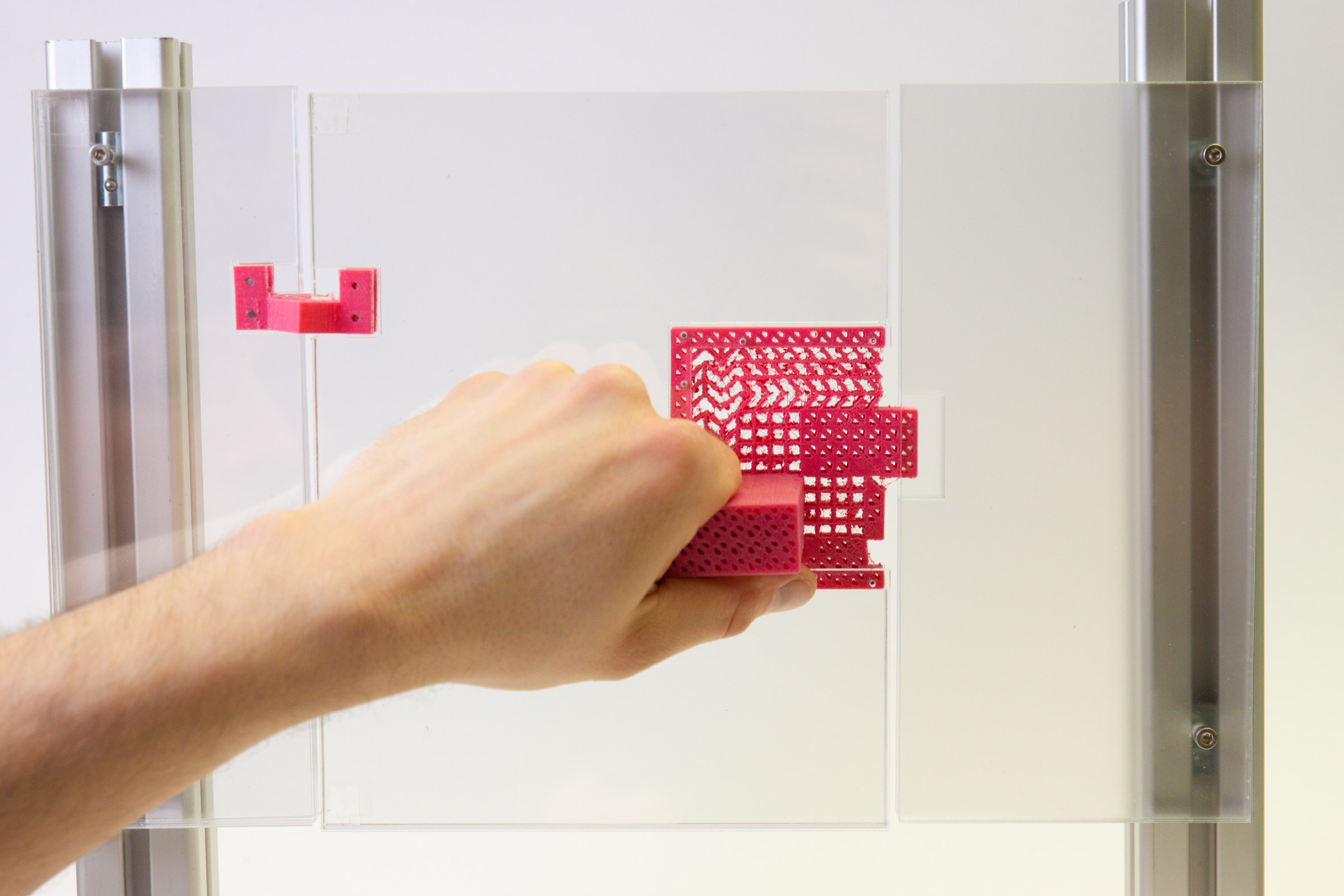


Metamaterials make it possible to create mechanisms from a single piece of plastic 
A door latch and a pair of pliers are among the mechanisms created without screws, bolts or other fixings by researchers working with a new technology called metamaterials (+ movie).
The team at the Hasso Plattner Institute's Human Computer Interaction Lab design objects that move despite being 3D printed as one single part.
To do this they use metamaterials – a type of engineered material defined by its internal structure rather than what substance it is made of. Metamaterials have properties not found in nature, as with the real-life "invisibility cloak".
The objects created can have controlled directional movement, which means they can perform set mechanical functions, like gripping something or latching a door. 


Uma ideia para se fazer em casa, que chama mesmo as atenções, é esta Máquina de Jogos digna dalguma Feira, é algo divertidíssimo de construír, e com sucesso certo:


HOMEMADE CLAW MACHINE

-MMM- in technologyrobots 

This is the second and new Version of my Claw Machine (Old Version)
As I announced in my first Version, the "new" Machine will be painted and setted up with an Arduino. 


E para uns Fins-de-Semana inesquecíveis, gastando pouco, que tal um Catamaran, feito com Espuma de Poliestereno, sim, Esferovite, ou Isopor, conforme o País, ora aqui está algo de fenomenal, e acessível à brava!


DIY styrofoam catamaran by Joshbuilds

outsideboats 
This is a Styrofoam catamaran i built. I had been wanting to build this for a while, then in the last few days of summer i decided to build it. This only took 2 full days to build and one day to test. The catamaran costed me around 200 dollars (sail not included) and this is comparable to a store bought catamaran which would cost 2000 dollars
In this instructable i have included a few schematics (located on the last page), a materials list, and various pictures and descriptions for all steps. 


E falando de coisas bacanas e acessíveis, vai aqui mais um belo dum Instructable, este, sobre como fazerem um Quadracóptero, com PVC, barato, e resistente, para se aprender a voar um Quadra, sem medos... 


The Ultimate PVC Quadcopter by thomasjarrett16

technologygadgets 
Whether you're a beginner looking for a quadcopter to help you get your feet wet in scratch building, or you're a little more experienced and are just searching for a cheap and reliable frame, look no further than The Ultimate PVC Quadcopter! This is a 450mm frame that is extremely cheap, at around $12 for all the hardware, and is extremely durable as well, mine withstanding dozens of near full speed crashes with nothing more than a couple of broken propellers! The electronics are 100% protected, either inside the PVC arms or underneath the lexan canopy, meaning 1: you'll never have to replace any electronic components and 2: you'll have the flyest (no pun intended :) ) looking DIY quadcopter around! This instructable is going to show you the creation process of this quadcopter and how to make it yourself! 


Dica da Sketchucation, se têem o Sketchup, isto é algo a juntar-lhe, para não perderem a paciência, após terem perdido uma hora de trabalho, por não terem gravado tudo, de 5 em 5 minutos...
Porque a história toda do que fizerem, está guardada, e podem voltar atrás, quando cometerem um erro, à vontade...
E podem usar um Modelo, para muitos usos, ou derivações, apenas mudando uns parâmetros, num Slider!


VIZ – Parametric Modeling for SketchUp 
Viz adds parametric modeling to SketchUp. All your modeling history is retained, you won’t need to redo all the work anymore. Often updating your complex model will turn out to be a matter of tweaking a couple of sliders.
Parametric Modeling
Boolean Operations and Constructive Solid Geometry
SketchUp 2014/2015/2016 Windows and SketchUp 2015/2016 Mac 


terça-feira, 20 de novembro de 2012

Solidoodle, Mindsets, e muito mais

Solidoodle vem na 3ª Versão, esta bem mais capaz de fazer o que querem em grande: 


Third-gen Solidoodle 3D printer pumps up the volume

Darren Quick

Over the past couple of years, the number of consumer 3D printers hitting the market has multiplied like … well, like plastic chess pieces churned out by a 3D printer. For its latest unit, Solidoodle has upped the build area to 8 x 8 x 8 inches (20 x 20 x 20 cm), which is two extra inches over the printable dimensions of the Solidoodle 2. This more than doubles the build volume from 216 in3 (3,540 cm3) for the Solidoodle 2 to 512 in3 (8,390 cm3) for the new Solidoodle 3.


Um Natal Engenhocas, eis o que a Mindsets oferece neste Kit de Cartões de Natal com Hi-Tech, usando a sua Caneta de tinta Condutora, para fazer Circuitos Integrados:


CHRISTMAS CARD KIT

The Christmas Card Kit provides an easy activity for students of all ages to make interactive gift cards while learning the basics of circuit building!
The kit provides three templates demonstrating how to draw a circuit in series and in parallel, as well as all the components needed to make three greeting cards using a conductive ink pen.

Contents:
1 x Conductive ink pen
3 x Christmas card templates
3 x Red Flashing LED
1 x Rainbow LED
3 x 3V Coin Cell Batteries

Order by 17th December to ensure courier delivery before Christmas.


Um Meta-Material, que age como uma Lente, e uma Lente extremamente precisa, para as Ondas de Rádio! Eis algo que vai dar que falar, nos mundos tanto da Rádio, como do Wi-Fi...


MIT produces new metamaterial that acts as a lens for radio waves

David Szondy

We expect the world to be predictable. Water flows downhill, fire burns and lenses bend light in a particular way. That worldview took a jolt as Isaac Ehrenberg, an MIT graduate student in mechanical engineering, developed a three-dimensional, lightweight metamaterial lens that focuses radio waves with extreme precision. That may not seem too disturbing, but the lens is concave and works in exactly the opposite manner of how such a lens should.
Metamaterials have an air of magic about them. The elements they’re made out of should work one way, but they way they’ve been fabricated make them operate in another. They are ordinary substances that have been engineered with precisely designed and fabricated microscopic structures. These structures interact with light or sound in such a way that they produce effects that are not found in nature. In the case of the MIT metamaterial lens, they result in a concave lens that should spread radio waves, but focuses them instead.


...E que tal Músculos Artificiais, com 85 vezes a força dum Músculo normal, do mesmo tamanho?
Parece coisa de Ficção Científica, mas isso já é normal, hoje em dia, tornar ideias fantásticas, realidade...
E com Nanotubos , e Parafina, sim, da vulgar Cera, das Velas!
Valha-nos Deus!

Wax-infused "nanoyarn" used to create artificial muscles

Adam Williams

An international team of scientists based at the University of Texas, Dallas (UTD), has developed a new type of artificial muscle created from carbon “nanotubes” – tiny hollow cylinders constructed from the same graphite layers found in the core of a standard pencil. Despite measuring 10,000 times less than the diameter of a human hair, the new muscles can lift more than 100,000 times their own weight, which amounts to approximately 85 times the power of a natural muscle of equivalent size.
The new muscles are manufactured by taking a twisted yarn of the miniscule carbon cylinders, then introducing a volume-changing “guest,” in this case the paraffin wax used in candles.


Mais um Instructable com o Arduino, e atenção, Cientistas de Campo, este é de categoria...
Vai de voar, medir, fotografar, ou vigiar o que quizerem, e sempre tomando nota da posição das medições!


Geo Data Logger: Arduino+GPS+SD+Accelerometer to log, time-stamp, and geo-tag sensor data

UPDATES
  • NOV 19: I have added a section with code to make this prototype act as a plain GPS logger without any sensors. 
  • NOV 19: I can confirm that the program for this project works with Arduino IDE 1.02. The problems I had earlier were a result of loose wiring. 

INTRODUCTION

I thought it would be educational to build a prototype that I can take on the road to log, geo-tag, and time-stamp sensors data to be analyzed later with mapping and data analyses applications.  So I figured why not start with a gadget that can log road conditions. This prototype, the Bump-O-Meter, measures road conditions by using an Arduino, a GPS receiver, an SD card, and an accelerometer sensor.

This prototype is a generic sensor logging/geo-tagging gadget which means the accelerometer can be replaced with any other sensor(s) to log anything anywhere. 

As a matter or fact my next adventure with this logger is to replace the accelerometer with a pollution sensor to visualize levels of air quality around town.


Os meus parabéns a este Programa que vai informando, e animando, os Portugueses no Brasil, sim Portugal,  não é só Bacalhau...

Assim é Portugal_Pgm186_Sao Joao da Madeira

 
Cidade de São João da Madeira e visita a fábrica Helsar de calçados e bolsas - Clip com Pablo Alborán e Carminho cantando o sucesso Perdoname.


Gostam de compar Bom e Barato?  
Uma dica do nosso amigo e Inventor, João Guerreiro;
Eis como podem comprar óculos que não custam os olhos da cara, e patricionar as nossas Fábricas...
COMPREM MADE IN PORTUGAL!


segunda-feira, 11 de outubro de 2010

Novidades

...Se não fosse a notícia, punha esta imagem aqui, à mesma, mas como também a notícia é boa, vai tudo...
Atenção, os Nano-Giroscópios, NÃO são estes!

Nano-Gyroscopes Will Let Cell Phones Navigate Indoors, Underground

By Julie Beck Posted 10.07.2010 at 12:16 pm

Israeli researchers have created the tiniest-ever optical gyroscopes, as small as a grain of sand, but still maintaining the keen accuracy of their counterparts hundreds of times larger. Optical gyroscopes are generally used for navigation in airplanes, ships and satellites, in which they track movement without reference to external navigation points, by measuring the vehicle’s rotation rate and linear acceleration. This is called inertial navigation. It’s extremely accurate but, up until now, only possible in gyroscopes and weighing two to three pounds.


A NASA vai mandar Aviões para explorar Marte...

NASA Moves Ahead With Robotic Plane to Take Mars Exploration to the Skies
By Clay Dillow Posted 10.07.2010 at 4:15 pm
As a general rule, when NASA flies a scientific mission all the way to Mars, we expect that mission to last for a while. For instance, the Spirit and Opportunity rovers were slated to run for three months and are still operating 6 years later. But one NASA engineer wants to send a mission all the way to the Red Planet that would last just two hours once deployed: a rocket-powered, robotic airplane that screams over the Martian landscape at more than 450 miles per hour.

ARES (Aerial Regional-Scale Environmental Surveyor) has been on the back burner for a while now, and while it's not the first Mars plane dreamed up by NASA it is the first one that very well might see some flight time over the Martian frontier. Flying at about a mile above the surface, it would sample the environment over a large swath of area and collect measurements over rough, mountainous parts of the Martian landscape that are inaccessible by ground-based rovers and also hard to observe from orbiters.
http://www.popsci.com/technology/article/2010-10/nasas-robotic-mars-plane-would-take-mars-exploration-skies
...E futuros Metamateriais que vão mudar as propriedades ópticas dos Painéis Solares, conforme o tempo que está a fazer:

Tunable, Stretchable Optical Materials
Active metamaterials might be used in solar cells that change properties with the weather.

By Katherine Bourzac
The field of metamaterials has yielded devices that seem to come from science fiction--invisibility cloaks, highly absorbent coatings for solar cells and ultra-high-resolution microscope lenses. Metamaterials are precisely tailored to manipulate electromagnetic waves--including visible light, microwaves, and other parts of the spectrum--in ways that no natural materials can.

With few exceptions, however, these materials work in a very limited range of wavelengths of light, making them impractical--an invisibility cloak isn't very useful if it only redirects light of one color but can be readily seen under others. Now researchers at Caltech have shown that by mechanically stretching an optical filter made from a metamaterial, they can dynamically change which wavelength of infrared light it responds to.
http://www.technologyreview.com/energy/26482/?p1=A5

terça-feira, 20 de julho de 2010

Novidades

Metamateriais!
Leiam com atenção, que vale a pena...

May 01, 2010

The Physics and Applications of Superconducting Metamaterials

We summarize progress in the development and application of metamaterial structures utilizing superconducting elements. After a brief review of the salient features of superconductivity, the advantages of superconducting metamaterials over their normal metal counterparts are discussed. We then present the unique electromagnetic properties of superconductors and discuss their use in both proposed and demonstrated metamaterial structures. Finally we discuss novel applications enabled by superconducting metamaterials, and then mention a few possible directions for future research.


The Advantages of Superconducting Metamaterials

Metamaterials are typically constructed of “atoms” that have engineered electromagnetic response. The properties of the artificial atoms are often engineered to produce non-trivial values for the effective permittivity and effective permeability of a lattice of identical atoms. Such values include relative permittivities and permeabilities that are less than 1, close to zero, or negative. For concreteness, we shall consider below the scaling properties of metamaterials made of traditional “atomic” structures, like those used in the early metamaterials literature. Traditional metamaterials utilize wires to influence the dielectric properties by manipulating the effective plasma frequency of the medium. The magnetic properties of Split-Ring Resonators (SRRs) are utilized to create a frequency band of sub-unity, negative or near-zero magnetic permeability.

Substantial losses are one the key limitations of conventional metamaterials. As discussed in detail below, Ohmic losses place a strict limit on the performance of metamaterials in the RF – THz frequency range. In contrast to normal metals, superconducting wires and SRRs can be substantially miniaturized while still maintaining their low-loss properties. For comparison, as the size of normal metal wires and SRRs are decreased. These deleterious effects do not happen with superconducting wires and SRRs because the resistivity is orders of magnitude smaller, and the electromagnetic response is dominated by the reactive impedance. Superconductors will only break down when the dimensions become comparable to the coherence length, or when the induced currents approach the critical current density (Jc ~ 10^6 – 10^9 A/cm2).


Novel Superconducting Metamaterial Implementations

A number of novel implementations of superconducting metamaterials have been achieved in addition to superconducting split rings and wires. Here we present results on several classes of superconducting metamaterials.

* Superconductor/Ferromagnet Composites
* DC Magnetic Superconducting Metamaterials

The general idea is to take a solid diamagnetic superconducting object and divide it into smaller units, arranging them in such a way as to tailor the magnetic response. The cloak would shield a region of space from external DC magnetic fields, and not disturb the magnetic field distribution outside of the cloaking structure.


* SQUID Metamaterials

They considered a two-dimensional array of RF SQUIDs in which the Josephson junction was treated as a parallel combination of resistance, capacitance and Josephson inductance. Near resonance, a single RF SQUID can have a large diamagnetic response. In an array, there is a frequency and RF-magnetic field region in which the system displays a negative real part of effective permeability. The permeability is in fact oscillatory as a function of applied magnetic flux, and will be suppressed with applied fields that induce currents in the SQUID that exceed the critical current of the Josephson junction. Related work on a one-dimensional array of superconducting islands that can act as quantum bits (qubits) was considered by Rakhmanov, et al. When interacting with classical electromagnetic radiation, the array can create a quantum photonic crystal that can support a variety of nonlinear wave excitations. A similar idea based on a SQUID transmission line was implemented to perform parametric amplification of microwave signals