Blog Posts

Mostrar mensagens com a etiqueta grafenos. Mostrar todas as mensagens

quarta-feira, 17 de outubro de 2012

Um Material DEZ VEZES mais forte que a Fibra de Carbono!

Não contentes com a Fibra de Carbono, estes magníficos Carolas da Universidade da Carolina do Norte criaram um novo Material, com Nanotubos de Carbono...
DEZ VEZES mais forte que a Fibra de Carbono!
Vai lá, vai...

Carbon nanotube composite material could replace carbon fiber

Ben Coxworth

When people need a material that’s strong yet lightweight, they usually look to carbon fiber. In the near future, however, they may instead choose to go with composite materials made from stretched carbon nanotubes. These materials could theoretically offer the same strength as carbon fiber at one-tenth the weight, or the same weight at ten times the strength. Researchers from North Carolina State University have recently succeeded in creating such a composite.
http://www.gizmag.com/cnt-composite-carbon-fiber-alternative/24593/


Autómatos bacanos em Papel, que vocês podem construír em casa, eis um que vos vai fazer rir, por muito tempo...
Um par de Sapatos que dançam em antecipação, ponham-nos a funcionar à volta da Hora de Saída do Emprego!
E mais um Pardal do caraças, vejam os dois:


Paper Models That Rock
Coming soon(ish)! Paper Models That Rock. My new book of pendulum powered projects is available for pre-order on the Amazon website. Other purveyors of fine books are available.
Below are pictures of two of the six projects contained in the book. I'll be drip feeding more pictures and information in the months until release (May 2013) Until then enjoy the impatient Tapping Feet


Uma notícia da Newsletter da Traceparts:
A famosa Marca de Impressoras 3D, a Objet, vai colaborar com eles, para promover a suas Máquinas pelo Mundo...
É lógico, porque assim, tem-se a vasta Colecção de peças em 3D da Traceparts, para Imprimir Protótipos, com análogos de todas as Peças que o Modelo, a ser fabricado em Série, vai mesmo usar.
Funciona? É só mandar fazer.


Objet calls on TraceParts to promote its 3D printers

TraceParts e-marketing campaigns target designers around the world

With several thousands of machines installed, Objet is one of the world leaders in 3D printing, a fast-growing technology for producing prototypes by additive manufacturing. Objet Ltd is headquartered in Israel, with offices in the United States, Europe, Asia, Australia, Japan and Mexico. The company also draws strength from a global distribution network.

The Objet 3D printer range (Eden and Connex, and desktop printers Objet24 and Objet30 Pro) cover a broad spectrum of requirements in terms of precision, effective volume and range of materials (107 available combinations). Objet's printers produce accurate, fine and detailed parts. These assets mean that Objet printers are in demand for design validation applications and functional testing, as well as jobbing and small production batches. Objet printers are used in a wide variety of sectors, from the manufacturing industry through to medicine, fashion, architecture, archaeology and education. 


Boas notícias, no Chiado temos a Noschool, que tem um Fablab, e um Curso, Malta Nova, com ganas de FAZER ALGO, vão lá:


 O que é?
NoSchool é um novo conceito educativo desenvolvido pelo artista Leonel Moura.
Insere-se no grupo Talent Universities.
NoSchool é um novo tipo de escola dedicada à criação pelos alunos de produtos inovadores. A função da escola é acompanhar e apoiar os alunos em todas as fases de desenvolvimento dos seus projetos, ajudando a uma melhor definição da ideia, sua implementação, produção, divulgação, marketing, venda ou criação de uma empresa.
A NoSchool procurará garantir a colaboração de professores e especialistas altamente qualificados, assim como uma interligação a empresas que poderão interessar-se pelos novos produtos em desenvolvimento.
A NoSchool, mais do que dotar os alunos de conhecimentos genéricos, pretende que estes criem produtos inovadores, prontos a serem lançados no circuito comercial, que os possam ajudar a encontrar uma saída profissional, integrar uma empresa ou montar um negócio.
http://www.noschool.pt/?page_id=40


...E por hoje é tudo, não sem antes vos falar desta ideia fabulosa, do Israel, uma Bicicleta em Cartão... Que custa 12 Dólares a Fabricar!

Israeli man creates bike from recycled cardboard

Adam Williams

Israel-based Izhar Gafni has invented a working bicycle which is constructed almost entirely from recycled cardboard, and only costs around US$12 to manufacture. The cardboard bike is being touted as an ideal solution for city-dwellers who require an inexpensive and environmentally-friendly way to commute, in addition to a potential mode of transportation for people living in emerging countries.
Gafni, a mechanical engineer and a cycling enthusiast, was inspired to make the cardboard bicycle after overhearing a conversation about somebody who had made a canoe constructed from cardboard. Thus began a project of three years, during which the inventor busied himself in his workshop, producing several prototypes, before settling upon a design which is cheap to make, robust, and suitable for daily use.

segunda-feira, 12 de setembro de 2011

David 3D, e mais

O programa David, um Scanner 3D cada vez melhor, está na versão 3.0:


A newsletter é tão cheia de coisas boas, que decidi apresentar uma parte, tal-qual:

New DAVID Version 3
Voilà: After more than a year of development, DAVID 3.0 is now available!
The most important innovation:
DAVID is the first and only software that supports both, "classic" Laser Scanning AND Structured Light Scanning! The Structured Light method is presented below.
Also, the completely new user interface (see below) makes DAVID3 more flexible, extendable and user-friendly.
Of course the new version is compatible to the same hardware: cameras, lasers, calibration patterns...
As always we offer a Free Version for everyone. Please feel free to test everything! Only saving results is limited. Download DAVID 3 now!
If you would like to purchase a license, please click here.
Of course if you already own a DAVID 2.x license or original USB key, you can upgrade to DAVID 3 at a lower price.

To purchase your upgrade, please contact your local reseller or visit our shop.

Structured Light Scanning
Structured Light (SL) makes scanning faster and easier! For this method you can use a standard video projector instead of the line laser.
This animation demonstrates the setup:


The video projector is connected to the PC and DAVID 3 uses it to illuminate the object with several stripe patterns. Click "Start" - wait a few seconds - see 3D result on screen!
Our Mexican reseller VISI Series has already tried it and made a short demo video (thank you!). Watch this video on YouTube.
Of course an SL setup needs to be optimized and calibrated (first the camera, then the laser). Our DAVID 3 user manual will guide you through it.
So what are the pros and cons of Structured Light Scanning compared to Laser Scanning:
+ Scanning without calibration panels in the background! (Panels are only initially required for camera and projector calibration.)
+ Much faster
+ One-click scan
+ No moving parts / no influence of hand tremors etc.
+ Can use photo camera, e.g. DSLR (still not recommended, but will be great and comfortable with a future DAVID version - work in progress)
- Projector prices are dropping, but they are still more expensive than lasers
- Room needs to be rather dark, usually darker than required for laser
- Not suitable for very small details on small objects because projectors usually can't be focused to very short distances
You should definitely give it a try!
E já vos disse que tem uma... Versão grátis desse programa?
Pois...

E como não fosse tudo eis mais 2 links para impressão 3D, sim, também da Newsletter!

All  in 3d:

Often, interesting ideas do not get the attention they deserve. In a presentation they lack that certain something, the transfer from intangible brainchild to tangible, true-to-life object. One or another idea can be acceptably outlined by pictures and texts, but any type of creative conceptual design turns into a real eye-catcher only when showing its third dimension. This is when imagination transforms into a physical likeness and literally takes shape, when a thought turns into a real “object of desire”.

At 3D-Idea, we make this come true for you.


...E Rapid Objects:
http://www.rapidobject-shop.com/en/products


Um Jet-Pack já à venda!

After Record-Making Flight, Martin Jetpack Will Soon Be on Sale
Buy one next year for just $100,000
By Gregory Mone

In May, inventor Glenn Martin—along with fire-rescue officers and crews on board a pair of chase helicopters—watched as his jetpack flew for nine minutes and 43 seconds, soaring 3,500 feet into the New Zealand sky. Had the machine been holding a live person instead of a 150-pound dummy, it would have smashed the record for the longest and highest jetpack flight ever. Every other such device in history has managed to be airborne for, at most, only a minute or two. But Martin was out to do more than set records with his demonstration. He wanted to prove that his design was safe enough to become the first commercial jetpack—one anyone could buy and fly.


E para o fim, por hoje, Nanotubos de Grafeno para substituír o fio de Cobre.

Lightweight Cable Made of Braided Nanotubes Could Replace Copper Wires
By Rebecca Boyle

Cables made out of nanowires could be just as efficient as the copper cables we’ve been using for more than a century, but at a fraction of the weight, according to a new paper. Braiding billions of carbon nanotubes into a nanowire cable can efficiently replace copper in a light bulb circuit.

Traditional cables are made by braiding or twisting together two or more wires or optical fibers, usually metal or silicon, to carry a current or signal. In a new study, Rice University researchers instead used double-walled carbon nanotubes, made of concentric rolled-up sheets of graphene.

terça-feira, 9 de agosto de 2011

6 Vídeos, 6 Métodos de Impressão 3D

Dúvidas sobre Impressão 3D?
Pois eis aqui, pela Ponoko, 6 diferentes métodos de Impressão 3D, explicados por Vídeo:


Vai aqui só o primeiro, vão ao Blog para os outros 5:

The different technologies behind 3D Printing

What we call “3D Printing” includes different fabrication methods. It would be more accurate to call it “Additive Manufacturing”. Only one technology works like printing and worth to be called 3D Printing: it’s 3DP.
- Stereo Lithography Apparatus (SLA) use a vat of liquid UV-curable photopolymer “resin” and a UV laser. Exposure to the UV laser light cures, solidifies the pattern traced on the resin. It was developed by Chuck W. Hull (co-founder of 3D Systems) in 1986
http://blog.sculpteo.com/2011/08/08/the-different-technologies-behind-3d-printing/


E os Grafenos estão cada vez melhores:
Graphene's 'quantum leap' takes electronics a step closer
by Staff Writers
Manchester UK (SPX) Jul 27, 2011

Writing in the journal Nature Physics, the academics, who discovered the world's thinnest material at The University of Manchester in 2004, have revealed more about its electronic properties.

Research institutes and universities around the world are already looking at ways to build devices such as touch-screens, ultrafast transistors and photodetectors.

Now the research from the creators of the material promises to accelerate that research, and potentially open up countless more electronic opportunities.

http://www.spacemart.com/reports/Graphene_quantum_leap_takes_electronics_a_step_closer_999.html


Também da Ponoko, para partir o coco a rir, estes carrinhos:

3d printed Mario Kart racers
Bored architect + Makerbot = totally awesome RC turtle shells

Michael Curry (aka Skimbal) has brought Mario Kart gaming nostalgia to life with his remarkably comprehensive Turtle Shell Racers.
I think we can all agree, life would become much more interesting if I launched a turtle shell at you every once and a while.
All of the .stl files are available on Thingiverse, including full assembly instructions and a parts list for the electronics, motor and other RC components needed to get those wheels turning.
http://blog.ponoko.com/2011/08/09/3d-printed-mario-kart-racers/


E já viram o TAMANHO desta Impressão 3D, atenção, do nosso amigo Junior, vejam isto!!!

O nível de detalhe é poreiro...
Este exemplo acima, faz-me lembrar que com o método da Resina permite vários materiais, tal como cera, para Fundição de Molde de Cera Perdida, para Ourivesaria!

segunda-feira, 6 de dezembro de 2010

Super-Condensadores!

Carregam com a capacidade de Baterias, mas podem carregar ou descarregar em segundos, os usos são inúmeros, para qualquer Engenhocas...

Technologically, the nano graphene-based, ionic liquid-enabled supercapacitor provides a specific energy density of 85.6 Wh/kg (based on the total electrode weight) at room temperature and 136 Wh/kg at 80°C, both measured at a current density of 1 A/g (corresponding to a high charge/discharge rate).

a) These are the highest energy density values ever reported for nano carbon material-based supercapaitors dominated by the electric double layer (EDL) mechanism, with minimal contribution from any redox-type pseudocapacitance mechanism.

b) These energy density values are comparable to that of the Ni metal hydride battery. This new technology provides an energy storage device that stores nearly as much energy as in a battery, but can be recharged in seconds or minutes. We believe that this is truly a breakthrough in energy technology.

The theoretical capacitance of graphene is 550 F/g (Farads per gram).
 http://nextbigfuture.com/2010/11/graphene-based-supercapacitor-with.html

quarta-feira, 6 de outubro de 2010

Novidades

A Rússia vai promover o Turismo Espacial:

Russia Aims to Launch First-Ever Commercial Space Station Within Five Years
By Julie Beck
A pair of Russian aerospace companies have announced plans to launch the first commercial space station, in 2015 or perhaps 2016. The station will have room for up to seven astronauts, scientists, and wealthy citizens to perform experiments or just take in the scenery. Meanwhile, U.S. company Bigelow Aerospace is also aiming to launch a private space station, possibly as soon as 2015 -- the race is on.

http://www.popsci.com/technology/article/2010-09/first-commercial-space-station-set-launch-5-6-years

...E foram atingidos os 60 MILHÕES de Rotações por Minuto!

Spinning Slice of Graphene Is Fastest Spinning Object Ever, At 60 Million RPM
By Dan Nosowitz

Graphene, Captured by a Transmission Electron Microscope National Center for Electron Microscopy

Scientists at the University of Maryland at College Park have managed to clock a floating piece of graphene at an unbelievable 60 million rpm, far faster than any other macroscopic object yet measured. Even crazier: Given graphene's strength, one of the scientists says that may only be a thousandth of its possible top speed.

Graphene is a derivation of graphite, which in turn comes from carbon. Basically, graphite comes from stacked sheets of carbon, and graphene is made of one-atom-thick separated graphite sheets, which form a honeycomb crystal structure. Graphene has some pretty incredible properties: It conducts electricity better than any other known material at room temperature and exhibits a startling amount of strength, given its 2D structure. A bit of graphene the same thickness as plastic wrap would require 2.5 tons of force to puncture it.

http://www.popsci.com/science/article/2010-09/fastest-spinning-object-ever-hits-60-million-rpm

sexta-feira, 23 de julho de 2010

Inovação tecnológica, uma lista do caraças!

Re-passo o que recebi, no email, vão la!


Computadores poderão substituir cientistas na geração de hipóteses

Segundo os cientistas, o fato é que os computadores estão se tornando cada vez menos dependentes dos seus criadores.    Leia mais...

NASA detecta maior molécula existente no espaço

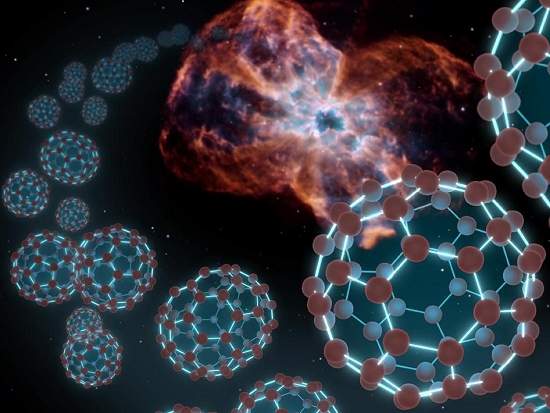
O Telescópio Espacial Spitzer descobriu no espaço, pela primeira vez, moléculas de carbono conhecidas como "buckyballs", uma espécie de bola de futebol formada por 60 átomos de carbono.    Leia mais...

Folhas luminosas de fibras ópticas superam deficiência dos LEDs

Os LEDs são muito eficientes, mas são pontos de luz. As novas folhas luminosas podem ser a resposta para a fome por polegadas adicionais das TVs mais modernas. Mas também para iluminar residências e o interior dos automóveis.    Leia mais...

Hubble captura estrela hiperveloz expulsa por buraco negro

O buraco negro capturou uma das três estrelas e arremessou as outras duas para fora da Via Láctea. As duas se fundiram para formar uma estrela azul superquente viajando a velocidades incríveis.    Leia mais...

Carro sem motorista viajará 13 mil pela Rota da Seda

O carro partiu de Milão, na Itália, e viajará por três meses até chegar a Xangai, em outubro, completando a histórica Rota da Seda.    Leia mais...

Estudos sobre plasma otimizam queima de combustível no motor

Aumentar a economia no consumo de combustível e reduzir a emissão de poluentes é o foco de uma pesquisa brasileira que envolve experimentos com plasma, o quarto estado da matéria e que está presente no processo de ignição.    Leia mais...

Material mata mosquitos e algas alterando superfície da água

Um líquido atóxico, criado por um pesquisador brasileiro, ao ser lançado sobre a água de lagos ou reservatórios, elimina algas e ainda mata várias espécies de mosquitos.    Leia mais...

Descoberta a estrela de maior massa do Universo

A R136a1 não é apenas a estrela de maior massa já encontrada, é também a de maior luminosidade, cerca de 10 milhões de vezes mais brilhante do que o Sol.    Leia mais...

Luz faz curva em U

Segundo a Teoria da Relatividade, a gravidade de um corpo celeste maciço curva o espaço ao seu redor. Os cientistas estão fazendo o mesmo com a luz alterando o chamado "espaço óptico".    Leia mais...

Brasileiro desenvolve técnica para criar os menores fios possíveis

Os nanofios poderão ser utilizados para superar as barreiras físicas do silício e em uma grande variedade de outras aplicações, como na distribuição de medicamentos pelo corpo humano.    Leia mais...

Hidroxila em rocha lunar desafia teoria da formação da Lua

Cientistas encontraram um "parente próximo" da água em um mineral trazido da Lua em 1971 pela missão Apollo. A descoberta questiona a "teoria do grande impacto", a mais aceita para explicar a origem da Lua.    Leia mais...

Intermitência espaço-temporal ajuda a entender o Sol e as bolsas de valores

Estudos sobre manchas solares, fisiologia respiratória, operações financeiras, meteorologia e outras áreas tão diversas como essas poderão se beneficiar de uma pesquisa realizada por físicos brasileiros e japoneses.    Leia mais...
Vão ao Site:
http://www.inovacaotecnologica.com.br/index.php

terça-feira, 22 de junho de 2010

Novas Tecnologias...

Um RADAR feito com material caseiro!


A DIY Synthetic Aperture Radar System for $250 
By Rebecca Boyle

Don't Worry, Air Force, It's Just a Model A homemade synthetic aperture radar system takes high-resolution images of small objects, like this model F-14 in maker Gregory Charvat's garage. Gregory Charvat
For about $250, you can make your very own space-age spy tech, following an MIT professor's instructions.
It can capture high-resolution images of small objects -- like a message written in push pins that had been hidden behind a foam plate.
Using a garage-door opener, microwave parts and a cordless drill, Gregory Charvat made a working synthetic aperture radar (SAR) system, the same kind of technology the military and NASA use. Charvat used algorithms to combine the back-scattered radar images into a high-res photos of things in his garage, like a Cannondale bike and a model F-14.
SAR is useful because it combines multiple radar images to create higher-resolution images than would otherwise be possible. There are a couple ways to do it -- by using a single antenna on a moving object, like an airplane or spacecraft, or by using multiple small antennae scattered over a large area. NASA uses SAR to create detailed maps of other planets, and it can be used to map the spread of oil in the Gulf of Mexico, for instance.
http://www.popsci.com/diy/article/2010-06/diy-synthetic-aperture-radar-system-250

Os Grafenos, outra vez, um écran flexível:

Flexible Touch Screen Made with Printed Graphene

Sheets of atom-thick carbon could make displays that are super fast.
By Nidhi Subbaraman


Graphene, a sheet of carbon just one atom thick, has spectacular strength, flexibility, transparency, and electrical conductivity. Spurred on by its potential for application in new devices like touch screens and solar cells, researchers have been toying with ways to make large sheets of pure graphene, for example by shaving off atom-thin flakes and chemically dissolving chunks of graphite oxide. Yet in the thirty-some years since graphene's discovery, laboratory experiments have mainly yielded mere flecks of the stuff, and mass manufacture has seemed a long way away.

See through: Researchers have created a flexible graphene sheet with silver electrodes printed on it (top) that can be used as a touch screen when connected to control software on a computer (bottom).
Credit: Byung Hee Hong, SKKU.


"The future of the field certainly isn't flaking off pencil shavings," says Michael Strano, a professor of chemical engineering at MIT. "The large-area production of monolayer graphene was a serious technological hurdle to advancing graphene technology."

Desta vez, são nanotubos, e melhoram a eficiência das Pilhas, assim como em, 10 vezes mais!
Nanotubes Give Batteries a Jolt
Lithium-ion batteries with nanotube electrodes could go longer between charges.
By Katherine Bourzac

A lithium-ion battery with a positive electrode made of carbon nanotubes delivers 10 times more power than a conventional battery and can store five times more energy than a conventional ultracapacitor. The nanotube battery technology, developed by researchers at MIT and licensed to an undisclosed battery company, could mean batteries that extend the range of electric vehicles and provide longer periods without recharging for electronic gadgets, including smartphones.

E uma pesquisa que promete duplicar o rendimento dos Painéis Solares, utilizando os electrões de alta energia, que até agora não são aproveitados:

Capturing "Hot" Electrons to Double Solar Power

Researchers demonstrate that high-energy electrons lost in conventional solar cells can be captured.
 
By Katherine Bourzac

There's a limit on the conversion efficiency of a conventional solar cell. No matter how it's tweaked, it can only convert 31 percent of the light that hits it into usable electrical current. That's because there's a broad spectrum of wavelengths in sunlight, and some of it has more energy than the active material in the solar cell can handle. High-energy light hits the active material in a solar cell and knocks loose electrons that have a similarly high energy--then these electrons rapidly lose that excess energy as heat.
Physicists know that if they could capture "hot electrons", they could more than double the efficiency of solar cells. The problem is that they lose their energy in a picosecond. Now, researchers have for the first time demonstrated that it's possible to capture hot electrons while they're still in their high energy state, before that heat loss happens.
Careful design at the nanoscale is key. Instead of a conventional bulk semiconductor, the researchers used quantum dots, because these nanomaterials can confine electrons over a longer timescale. "Nanomaterials can keep electrons electrons hot for a longer period of time, so that you can get them out," says Xiaoyang Zhu, professor of chemistry at the University of Texas, Austin.
http://www.technologyreview.com/blog/editors/25345/

sábado, 19 de junho de 2010

Notícias

Uma Córnea Artificial, foi criada na Europa, e poderá restaurar a visão a Milhares de pessoas:
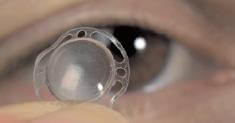
An artificial cornea (prototype shown here) could restore sight to thousands starting this year


Germany’s Artificial Cornea Ready To Restore Sight To Thousands
June 2nd, 2010 by Aaron Saenz

An expansive EU project to produce an artificial cornea has found success thanks to the work of Joachim Storsberg of the Fraunhofer Institute for Applied Polymer Research IAP in Germany. Storsberg helped develop a new version of an opthalmological polymer which the eye will bond to and still allow to function properly. The new polymer could help restore sight to thousands waiting for corneal transplants around the world. The artificial cornea has passed clinical trials and is ready to see expanded use in patients this year. Very soon those with corneal blindness may find a ready cure in the form of the new implant.

Corneal blindness affects millions around the world. According to the WHO, about 5 million cases of blindness in the world (as of 2001) were a result of corneal damage or dystrophy. We’ve seen several high-tech approaches to fighting corneal blindness including the application of embryonic stem cells to generate new tissue. For most of those affected around the world, however, corneal transplants represent the surest and most accessible treatment for their condition. A readily accessible, easily made artificial cornea is a huge boon to corneal transplants.

Telescópios de Alta qualidade, para o Povo!

The 91-actuator Array That Manipulates the Liquid Mirror:  Denis Brousseau, et al.

Liquid Mirror Breakthrough Could Make State-of-the-Art Optics Cheap
By Clay Dillow

A $120 million Earth-based telescope using brand new adaptive optics just trumped Hubble's deep space image clarity three-fold, but such high tech optics aren't just reserved for high-dollar observatories. A breakthrough in deformable liquid mirror technology could drastically reduce the price associated with adaptive optics, making the best in high-tech telescopes more widely available.

Imagine a volume of reflective liquid like mercury in a bowl. Spin the bowl, and the liquid will push toward the edges, forming a concave mirror as smooth as the best mirror glass. But unlike highly specialized mirror glass, it's just a bowl of mercury. It costs next to nothing by comparison. 


...E o Grafeno caminha a passos largos para um PC perto de vós, agora já desenharam padrões neles: 
Writing Circuits on Graphene
A heated AFM tip can draw nanometers-wide conductive lines on graphene oxide.
By Prachi Patel
Hot wire: An AFM tip heated to over 150 °C can etch an insulating graphene oxide surface to create thin conductive nanoscale wires.
Credit: Debin Wang, Georgia Tech

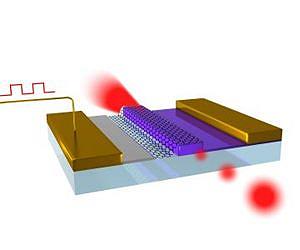
Using a heated atomic force microscope tip, researchers have drawn nanoscale conductive patterns on insulating graphene oxide. This simple trick to control graphene oxide's conductivity could pave the way for etching electronic circuits into the carbon material, an important advance toward high-speed, low-power, and potentially cheaper computer processors.

Graphene, an atom-thick carbon sheet, is a promising replacement for silicon in electronic circuits, since it transports electrons much faster. IBM researchers have already made transistors, the building blocks of electronic circuits, with graphene that work 10 times faster than their silicon counterparts. But to make these transistors, researchers first have to alter the graphene's electronic properties by cutting it into thin ribbons, which are then incorporated into devices. Researchers have made these nanoribbons with lithography, with chemical solution-based processes, or by unzipping carbon nanotubes. 
Graphene, an atom-thick carbon sheet, is a promising replacement for silicon in electronic circuits, since it transports electrons much faster. IBM researchers have already made transistors, the building blocks of electronic circuits, with graphene that work 10 times faster than their silicon counterparts. But to make these transistors, researchers first have to alter the graphene's electronic properties by cutting it into thin ribbons, which are then incorporated into devices. Researchers have made these nanoribbons with lithography, with chemical solution-based processes, or by unzipping carbon nanotubes.
http://www.technologyreview.com/computing/25547/

quinta-feira, 17 de junho de 2010

Notícias

Mias perto ainda da Fusão. 30.000 Joules com cada pulso de fusão:
Lawrenceville Plasma Physics High Yield Pulses to Megawatt Generators
Share


Lawrenceville Plasma Physics (LPP) has a goal of generating 30,000 joules with each nuclear fusion pulse. This would be net energy with conversion to elecricity. So if 100,000 joules was put in from the capacitors then they would need say 200,000 joules back and convert that to 130,000 joules. 100,000 joules for the next shot and 30,000 as excess energy. they are currently only around the 1 joule level. In April it was 0.1 joule, but in May the current increased to 1 megaamp which suggests about 1 joule output.

LPP plans to then increase the pulse rate to 60 pulses per seconds. It would be producing 1.8 million joules per second.

A one megawatt generator produces one million joules per second. (a watt is a joule/ second)

LPP was also trying to get up to 100,000 joules in each pulse. 60 such pulses would be 6 million joules per second, which if converted at with only about 20% loss would be equal to a 5 megawatt generator.

31.536 million seconds per year * 30,000 joules * 60 pulses per second / 3600 seconds =
8760 hours * 60 * 30,000 watt hours = 15.768 million Kilowatt hours


newbox.TV


http://nextbigfuture.com/2010/06/lawrenceville-plasma-physics-high-yield.html
Progressos na Des-Salinização da Água do Mar:


Saltwork Technologies Desalination and Efficiency of Other New Desalination Approaches
Saltworks' patent pending technology employs an innovative Thermo-Ionic™ energy conversion system that uses up to 80 per cent less electrical/mechanical energy relative to leading desalination technologies. The energy reduction is achieved by harnessing low temperature heat and atmospheric dryness to overcome the desalination energy barrier. Saltwater is evaporated to produce a concentrated solution. This solution, which has concentration gradient energy, is fed into Saltworks' proprietary desalting device to desalinate either seawater or brackish water. Some electrical energy is used to circulate fluids at a low pressure, yet the bulk of the energy input is obtained through the evaporation of saltwater.
http://nextbigfuture.com/2010/06/saltwork-technologies-desalination-and.html

Grafenos, o futuro da Electrónica:

Doping Graphene
Dopant chemicals adhere to a graphene sheet, modifying its properties for the development of ultra small and fast electronic devices. Credit: American Physical Society
by Staff Writers


College Park MD (SPX) Jun 07, 2010
An organic molecule that has been found to be effective in making silicon-based electronics may be viable for building electronics on sheets of carbon only a single molecule thick. Researchers at the Max Plank Institute for Metals Research in Stuttgart report the advance in a paper appearing online in the journal Physical Review B on June 1.
Ultrathin carbon layers known as graphene show promise as the basis for a host of extremely small and efficient electronic devices. But in order to create a useful component, the electronic properties of materials like silicon or graphene must be tailored through a doping process.
http://www.spacedaily.com/reports/Doping_Graphene_999.html