Blog Posts

quinta-feira, 6 de setembro de 2012

Querem ìmanes? Muitos ìmanes?

Porque não posso estar parado, eis que vos arranjei um Fornecedor de Ímanes de Neodímio, e não só!


Assim, quando encomendarem a minha Armação para o Arranjo Halbach de 12 Ímanes, na Sculpteo, podem encontrar lá os Ímanes, num Link bacano, carreguem no texto e ele expande, lá está, debaixo da Imagem KJMagnetics, o Link, a azul:


Atenção, podem encomendar esta Armação, para outros tamanhos, que o de 10mm. Carrregam em Costumize, como diz na mensagem a amerelo, que aparece;


E quando escolherem o Material, também podem escolher o tamanho!


Assim, sabendo que esta Armação, é feita para cubos de Neodímio de 10mm, basta calcularem o que precisam de aumentar ou diminuir, para lá caberem os vossos Ímanes!

E se quizerem Barras em vez de Cubos, lembrem-se de escolherem Ímanes magnetizados ao longo da altura, e não do comprimento da barra, e compram 2 ou 3 Armações, cortando o fundo às Armações da frente, e deixando apenas a detrás.

quarta-feira, 5 de setembro de 2012

Papel couraçado, Zootrópio... Em Papel, Razorlabs, e uma Espingarda Gauss

Onde é que havíamos de imaginar, uma Couraça... Em Papel?
Pois cá está ela, e é mais forte que a Fibra de Carbonno, ou o Kevlar!!!
Obra dos Serviços Florestais dos Estados Unidos, (!), vai revolucionar uma data de Indústrias, digo-vos eu...
Pois não é que este Material, ainda por cima é TRANSPARENTE?


Wood pulp extract stronger than carbon fiber or Kevlar

By Brian Dodson

The Forest Products Laboratory of the US Forest Service has opened a US$1.7 million pilot plant for the production of cellulose nanocrystals (CNC) from wood by-products materials such as wood chips and sawdust. Prepared properly, CNCs are stronger and stiffer than Kevlar or carbon fibers, so that putting CNC into composite materials results in high strength, low weight products. In addition, the cost of CNCs is less than ten percent of the cost of Kevlar fiber or carbon fiber. These qualities have attracted the interest of the military for use in lightweight armor and ballistic glass (CNCs are transparent), as well as companies in the automotive, aerospace, electronics, consumer products, and medical industries.


Em Papel, mas do tradicional, da espécie da Cartolina, uma Peça de Museu da Tecnologia que vocês podem construír e ter em casa, este excelente Zoótropo do nosso amigo Rob Ives, está porreiro: 


Zoetrope - come and get it!
Wed 5th Sep 2012
The zoetrope is a clever mechanism used to display animations. Popular in Victorian times the zoetrope has stood the test of time and is now available to download and make in cardboard form!


Turn the handle and the cylinder, with interchangeable picture strips, spins displaying an animated scene.
Members can download the files for free at the link above. non-members can download it for only £2.50. Print out the parts onto thin card. Note that there is a coloured version and non-coloured version in the file.

http://www.robives.com/blog/zoetrope


Já está um Artigo meu publicado na Razorlabs, por isso, deixem-me exibi-lo...


New BusStopper! September 5th, 2012

Time to welcome our first Guest Blogger, Edgar Castelo. His post below introduces one of his new inventions, enjoy!

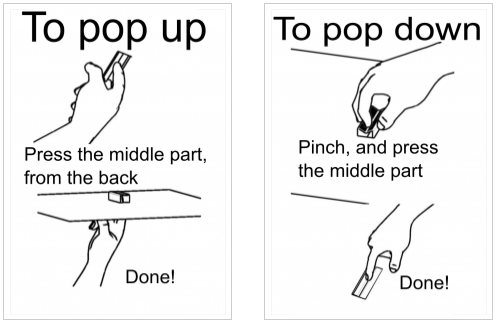
Segments pop up, they appear, pop down, they disappear.
Couldn’t be simpler!
Cut the 3 Digits drawing, Bus2 02, on a thick material, and print the segments template, Bus2 01, on Cardboard, bending over the grey lines, and the middle of the black part. Rivet the holes, you got a Bus Stopper!
bs2
Get the plans, here:
Thanks to Edgar for contributing to our blog. If you would like to do the same, see our post on how here and get in touch.


Apreciado no Estrangeiro, ignorado em Portugal... Se calhar, até é melhor assim! LOL


Uma nova Espingarda Gauss, claro que isto é uma espécie de Brinquedo... Ou quase! 
Muáháháhá!
Obra do Cyberpunk Alemão Patrick Priebe, prova-nos que se alguma "autoridade" diz que algo "é impossível", estamos a alguns meses de ver esse "impossível" nas lojas!


Gamers may get a charge out of the Gauss Rifle

By Ben Coxworth

Well, Patrick Priebe might have outdone himself with this one. In the past, the German cyberpunk weapons-maker has brought us such creations as a wrist-mounted mini-crossbow, a laser-sighted rotary-saw-blade-shooting crossbow, and a flame-throwing glove. His latest nasty futuristic device? A video game-inspired electromagnetic weapon, called the Gauss Rifle.
Priebe told us that he took his inspiration from the K-Volt weapon, featured in the game Crysis 2. While he liked the look of the game’s version of the gun in first-person view, he wasn’t as keen on how it looked when placed on the ground ... so, he made his own version.
The 400-volt semi-automatic Gauss Rifle is what’s known as a multistage coilgun. It shoots 5.7-mm steel ammunition, from a built-in 8-slug clip. Priebe did his best to explain to us non-weapons-makers just how that ammo is fired.


http://www.gizmag.com/gauss-rifle-multistage-coilgun/23988/


E para acabar em beleza, por hoje, que tal este Vídeo, bem espectacular, sobre Impressão 3D, da Shapeways?
Sentem-se bem, e... APRECIEM!


3D Printing & the Culture of Creativity
Every day at Shapeways, thousands of people make their ideas real with 3D printing, and as a result, the Shapeways community is igniting a culture of creativity. So we're thrilled to launch a series of films about 3D printing and how this incredible technology is changing all of our lives.

This first video provides an inside look into the Shapeways vision, community, and 3D printing magic. If you're inspired, help ignite the culture of creativity and share the film!

terça-feira, 4 de setembro de 2012

3D para os Filmes, o Avião Transversal, e uma ideia nova para o Open Source

Eis uma para os Filmes, literalmente, a nova aventura dos Men in Black, vai envolver "Armas" Impressas em 3D!
Trazida até nós pelo Blog da Ponoko, este até tem um Vídeo para verem como é...

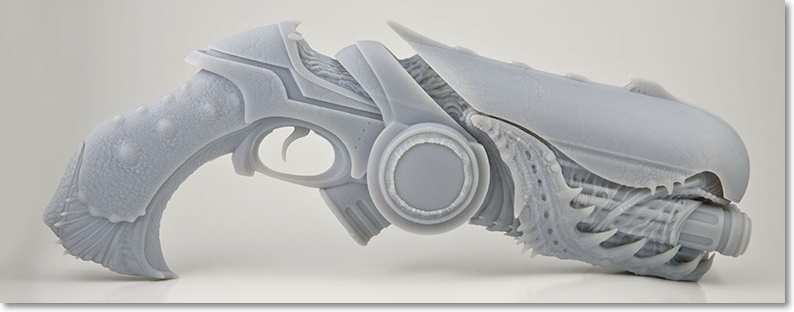
3D printed futuristic weaponry for Men in Black 3 

These futurist handguns for Men in Black 3 were made by Moddler, a custom 3D printing company in San Francisco, using their in-house Objet Eden500. This is a very high-end printer capable of printing multiple material materials on the same part. The gun above is printed in hard plastic with soft, spongy rubber grips.
Watch Moddler’s video for a look inside the company.

http://blog.ponoko.com/2012/09/04/3d-printed-futuristic-weaponry-for-men-in-black-3/


Um Avião, dois tipos de Asa, basta RODAR 90 GRAUS, em pleno voo!
Ora aí está uma ideia do caraças...

Radical bi-directional flying wing design gets NASA funding

By Darren Quick

A team that has created a supersonic jet design resembling a flying shuriken has been awarded a US$100, 000 grant from NASA’s Innovative Advanced Concepts (NIAC) program to continue development of the aircraft. Aside from looking suitably futuristic, the concept plane’s four-pointed star design serves a practical purpose. By rotating in mid air, the plane can transition between broad-wing subsonic and shorter wingspan supersonic configurations.
http://www.gizmag.com/rotating-bi-directional-flying-wing-design/23982/


E uma ideia que nos aparece via The Firearm Blog, que poderá servir, ou não, a tanto Inventor-Empresário, que não vende o suficiente, abrir o desenho para Open Source...
E viver de vender as Peças Sobresselentes!
Será bem melhor que desistir de todo, penso eu...

Open Source the GMG (Fully Auto Airgun)?

The makers of the GMG .22, a fully automatic air gun, are considering open sourcing the design. Sales have not been good and they think there could be more money selling plans, kits and parts than fully assembled guns.

I think they should open source the design and release the plans and any CAD models under a Creative Commons license.
If they can create a community of builders and modders there could be a profitable business in selling parts, kits and upgrades.
This business model has worked well in the hobbyist electronics market where mini-industries develop around supplying parts and kits for open source hardware.
The company is running a poll on their website, asking if people would be willing to buy parts, rather than an entire gun.


segunda-feira, 3 de setembro de 2012

Para todos os fins...

Eis uma forma de exprimirem o vosso descontentamento, permanentemente, e em 3D, e com o que quer que seja!
Imprimem esta Figura Universal de Desagrado, MAS com uma qualquer Foto ou Sigla, etc, que vos dê na gana!

É só mandar imprimir em Multicolor, e carregar em Costumize it, á direita, e depois mandarem para lá uma Foto.
Carreguem onde querem que a foto apareça, neste caso, de lado, e até podem escolher o tamanho. 
Quando gostarem do resultado, mandam fazer, e...
Pronto!


Adult Humor Potty 3D Joke

An Adult Humor way to express you disgust with...
Anything! LOL
Just choose Multicolor, as the Material, and click on Costumize.
Add a Picture, and point on the point you want the Pictiure to be, so you add a Picture to the Object, and print your 3D Opinion.

http://www.sculpteo.com/en/design/adult-humor-potty-3d-joke-1/qFFSezuZ

Inovação Chinesa, Objectos Voadores, Organizem-se, e Pedro Nunes

Eis uma ideia Ovo-de-Colombo... 
Que tem mesmo a ver com Ovos! 
Prova que os Chineses estão a Inovar, uma simples Garrafa de àgua separa as Gemas dum Ovo!


Quer para os Caçadores de OVNIs, ou Observadores de Aves, como Entusiastas da Aviação, etc, etc, eis um App que permite aos SmartPhones medir a distância, direccção e velocidade dum Objecto à distância:


Smartphone app determines location, speed and direction of distant objects 
By Darren Quick

Researchers at the University of Missouri have developed a prototype app that combines a smartphone’s GPS, compass and imaging capabilities to calculate the exact location of distant objects and track their speed and direction. The researchers say the PositionIt app could allow a single off-the-shelf device to replace various pieces of equipment carried by soldiers on the battlefield, or be used closer to home to judge the distance to the green when playing golf. 


Como não podem acrescentar espaço às vossas casas, acrescentem espaço às vossas Bancadas, para arrumar toda a Tralha que as entope todas... Até tem uma Bobine para fio, e tudo:


Easy work bench organizer with wire dispenser
dtextor
I have a small work bench in my room to work with electronics. Since it is small it's always crammed (see the BFEORE picture...) and I end up working on the office table. I took some waste wood that I had lying around and built that work bench top. It's super easy to build and helps a lot to keep the place usable.


E mais Tugas brilham lá fora,o Instituo Pedro Nunes, vai figurar num Projecto Internacional de Inovação, ao largo dos Estados Unidos:


Instituto Pedro Nunes convidado para projecto de incubadora de empresas em águas internacionais

02.09.2012 - 19:36 Por Lusa

O Instituto Pedro Nunes (IPN), de Coimbra, vai integrar um projecto internacional de criação de uma incubadora de empresas em águas internacionais, a cerca de 22 quilómetros de Silicon Valley, nos Estados Unidos da América.

Silicon Valley é uma região dos EUA onde está instalado um conjunto de empresas que tem como o objectivo gerar inovações científicas e tecnológicas.

Teresa Mendes, directora do IPN, explicou que a empresa irá participar no projecto Blueseed que pretende instalar uma incubadora de empresas num navio em águas internacionais, para que as empresas interessadas possam temporariamente desenvolver negócios e parcerias sem as exigências de visto de trabalho dos EUA.

“Esta localização, em águas internacionais, permite a empreendedores não americanos desenvolver os seus negócios em Silicon Valley, aligeirando a carga burocrática”, disse hoje a responsável à agência Lusa.

http://economia.publico.pt/Noticia/instituto-pedro-nunes-convidado-para-projecto-de-incubadora-de-empresas-em-aguas-internacionais--1561412


sábado, 1 de setembro de 2012

Nitinol! Construam a vossa Máquina-Maravilha

É muito bacano, quando se pode ver um Vídeo destes, e a seguir, comprar pela Internet o Nitinol para fazer isto aí mesmo, em casa!


Há muitas mais fontes de Nitinol, mas esta é uma delas, e uma, que já conhecemos: 

Memory spring and memory wire
Memory Wire
This nickel/titanium (NiTi) alloy initially ‘remembers’ that it should be straight. If it is bent into a different shape and then dropped in very hot water (90°C), it springs back to its original straight condition. It will repeat this behaviour any number of times.
The wire can also be heat treated to remember different shapes. It simply has to be held in the desired shape and then heated to 500°C in a small oven for a few minutes. This means that pupils can now get involved in creating smart springs and other components that a few years ago would have challenged front line researchers.
Memory wire has several important medical applications. It is used, for example, to make surgical stents – small woven frames that balloon outwards to open blocked arteries. It is also used for orthodontic braces. Some smart textiles use woven-in memory wire to change the shape (and support) of garments when they reach body temperature. Because it can be heat treated, the potential of memory wire in designing and making is virtually unlimited.
The wire is sold by the metre.
Two-Way Memory Spring
These remarkable springs, based on a brass alloy, ‘remember’ to open up at around 90°C and close again when cool. If immersed in hot water at or around 90°C they will open in a split second and close as quickly if dropped in cold water. Such springs have many industrial applications – e.g., in sprinkler and fire damping systems where they replace expensive single-use only fusible links.
Memory springs open and close with considerable force and are used in countless applications where movement is wanted at the opening and closure threshold temperatures.


Segundo a DesignSpark, o Hardware é a nova Web, em termos de influência verdadeiramente revolucionária, na Sociedade:


Hardware is the New Web

An Arduino workshop at the Noisebridge hackerspace in San Francisco (© Mitch Altman, CC BY-SA 2.0)
With hardware start-ups on the increase, countless gadgets funded via Kickstarter and a resurgence of interest in electronics as a hobby, it looks as though hardware is set become the new Web.
From the first public radio broadcast in 1910 to the home computer revolution of the 1980s, electronics served as the most visible face of technology in the 20th century. When for almost 100 years everyday lives were being transformed by a stream of new appliances, intrepid early adopters could get a slice of the action if they could solder, and electronics empires were being born in garages.
With the arrival of the PC and then the Web we saw a shift in focus, and while software requires computers and the Internet is built upon networking and communications hardware, these took a backseat position and applications and online services garnered more attention. All the hottest start-ups were online and many budding engineers took to software development rather than soldering.
As we move further into the 21st century it appears that the balance may be redressed, with attention shifting back towards hardware — or perhaps products that span both physical and online worlds. What follows is a brief look at some of the enablers, drivers and indicators of this shift.


E para acabar, que hoje é Sábado, um Braço Robótico mais que flexível...


Homenagem a Nagashima, Um Amigo de Portugal

Um Amigo de Portugal


Eis a minha homenagem ao grande Pintor de Lisboa, Minoru Nagashima.

E os seus mais recentes quadros, incluíndo um, o mais à direita, que ele estava mesmo a pintar, naquele momento, hoje:

E eis um excerto sobre o Artista, tirado da sua Página, vão lá:


Minoru Nagashima
Não haverá uma pessoa que não o conhece se ouvir "pintor japonês" no Principe Real, um jardim no centro da cidade de Lisboa.
Deveriam haver muitas pessoas que se admiravam ao ver Nagashima que transportava diariamente uma bolsa de pintura e cavalete para pintar os seus quadros a óleo.

Passaram 10 anos e hoje em dia as pessoas em Lisboa apelidam Nagashima, com um sentimento amigável.

Minoru Nagashima, nasceu em Takasaki Gunma em 1943. Tem uma carreira que pertenceu ao Grupo de Daichowakai e toda a sua vida exerceu a actividade de arte de pintura.
Quando Nagashima visitou Portugal pela primeira vez, com um grupo de artistas em 1998, ficou encantado pelo bom clima, o calor das pessoas e amizade. Nagashima iniciou a sua actividade de pintura, em Portugal, em 1999.
Nesta altura fez uma exposição privada em que retrata nos seus quadros principalmente a paisagem portuguesa e uma exposição, Tóquio, em 2000.
Depois Nagashima mudou-se para Portugal e continuou a praticar a sua de actividade intensamente, onde tem pintado a paisagem portuguesa.
 http://luzdelisboa.site50.net/nagashima.html