Blog Posts

Mostrar mensagens com a etiqueta thinghiverse. Mostrar todas as mensagens

terça-feira, 12 de setembro de 2017

Robots de Papel! E Inventores de Drones, um Móvel para as Ferramentas, Electricidad de pesos, e um fidget!

Robots de Papel! 
Isto é muito bem achado, da Industry News... 
Robots que se movem como Minhocas, e podem mover-se por aí, muito mais baratos, pequenos,  e fáceis de fazer.
Não vai passar muito tempo até que se faça disto por toda a parte, e nem sei se não vai alguém fazer uma espécie de micro Stepper, e daí uma micro-CNC! 


Researchers Make Robots Out of Paper 
A team of researchers from the University of Illinois Department of Mechanical Science and Engineering has made a pair of crawling robots, Peri and Poly, out of little more than a sheet of paper, a few 3D printed parts, and a handful of screws.
The researchers used origami paper folding to create cheap robots that move like earthworms.
Poly is 51 mm wide and uses a pair of origami towers that expand and contract when twisted to make the worm robot crawl forward. The robot has directional feet made of hard plastic and rubber. The 3D-printed toes allow the robot to slide forward while the rubber heal stops it from backsliding. This particular example of bio-mimicry was inspired by the setae on earthworms.
Peri is more than twice the size, and fully mobile. Peri is 106 mm wide and runs on batteries unlike the Poly, which is tethered to the power source. Peri also uses on-board controllers to navigate. 


Podem pôr a Míudagem a fabricar Drones, aprendendo técnicas que os vão potenciar para um futuro emprego.
É bom!
Vem com mais de 16 Missões, mas o que é SÓ isso para um Engenhocas? As aplicações são INFINITAS!
MUÁHÁHÁHÁHÁ!


DROID™ INVENTOR KIT 
Kids can create their own custom Droid and bring it to life it with littleBits electronic blocks.
Create a Droid from scratch
Go on 16+ missions in the free app
Customize & reconfigure for new powers 
https://shop.littlebits.cc/pages/starwars


Cá está uma coisa que faz falta a todos os Engenhocas e Fabbers, para arrumarem a Tralha em que se transforma a vossa querida colecção de Ferramentas e etc.
Grátis, e para irem cortar na Fablab local, que eles quererão logo cortar umas tantas para eles mesmos!


The Amazing Tool Organizer (lasercut)jasonwelsh 
Summary
Have tools? Have a desk?  OCD?
You need this! 
https://www.thingiverse.com/thing:1813105


Da Página da Facebook, Zink, vem esta ideia muito bem-vinda, usar o velho mecanismo de pesos dos Relógios, para produzir electricidade para iluminar uma casa, em zonas sem Rede Eléctrica.
Muito Bom.


The Problem
 
Over 1.2 billion people globally have no access to electricity and millions more have an unreliable supply. Instead they use dangerous, polluting and expensive kerosene lamps for light.
A typical kerosene lamp is made by taking an empty bottle or tin can, putting a wick in the middle, filling it with fuel and lighting. Using kerosene for lighting is extremely inefficient, dangerous and expensive, and it has extensive health and environmental drawbacks.

How It Works
Combining kinetic and potential energy, GravityLight works by connecting an elevated weight — filled with rocks or sand — to a pulley system that slowly powers a generator as the weight falls to the ground. 


Para se divertirem um pouco, fiquem com esta ideia, que é uma boa maneira de renovarem a Novidade dos Fidget Spinners:


Electromagnetic Fidget Spinner Accelerator
tanner_tech  
Fidget Spinners are little plastic toys with a bearing in the center. They are fun for a little bit, but get boring after a while due to their slow spinning speeds. There are ways to make them spin faster, but these methods involve using a bulky air compressor or an expensive can of compressed air. Luckily, I have found a cheap way to accelerate these fidget spinners to extremely high speeds with the power of electromagnetism. You can even hold the spinner in your hand while you accelerate it! I have clocked a spinner that is spinning with this accelerator at speeds up to 1440 RPM, that is fast. You can build this accelerator too, it is really cheap and really simple to build. 


domingo, 9 de outubro de 2011

Mais uma Engenhoca

Encontrei isto;


Como achei o princípio interessante, fiz uma versão para o Thinghiverse, 


Por isso, se tiverem acesso a uma Impressora 3D, vão lá:

http://www.thingiverse.com/thing:12306

terça-feira, 4 de outubro de 2011

Novidades

A Altlab de Lisboa tem as seguintes Actividades:
altlab - Lisbon's Hackersapce
Figo Maduro, Lisboa


Um Novo Material que pode ser feito no Micro-ondas!


New heat-harvesting material made in $40 microwave oven

By Ben Coxworth

Virtually all electrical devices and industrial processes create heat as they operate, which is typically wasted. In the past several years, various thermoelectric technologies have been developed to address that situation, by converting such heat into electricity. The ideal material for the purpose would be one that has a high electrical conductivity, but a low thermal conductivity - that way, it could carry plenty of electricity without losing efficiency through overheating. Unfortunately, electrical and thermal conductivity usually seem to go hand in hand. With some help from an ordinary microwave oven, however, researchers from New York's Rensselaer Polytechnic Institute have created a nanomaterial that appears to fit the bill.

The team started with zinc oxide, which is already pretty well-suited to heat harvesting, as it is nontoxic, cheap, can have its electrical conductivity boosted, and has a high melting point. It is also, however, fairly thermally conductive.

In collaboration with the University of Wollongong, Australia, the researchers proceeded to add tiny amounts of aluminum to samples of zinc oxide, then processed the two materials together in a microwave oven. The resulting aluminum-doped zinc oxide nanocomposite retained the original zinc's electrical conductivity, but had a much lower thermal conductivity.


E mais um argumento prós Professores de Matemática, a dita cuja até serve para ajudar a criar NOVOS PLÁSTICOS!


Mathematical model could streamline the development of new plastics


By Ben Coxworth

When it comes to the development of new plastics, two things have generally happened - a plastic is created and then a use is found for it, or a long trial-and-error process is undertaken in order to create a plastic with specific qualities. In a move that has been described as "comparable to cracking a plastics DNA," however, scientists at the University of Leeds and Durham University have created a mathematical model that should allow specialty plastics to be created much more quickly and efficiently.

The model incorporates two pieces of computer code. One of those is designed to predict how different polymers will flow, based on the the connections between their string-like molecules. The other predicts the shapes that those molecules will take on, when created at a chemical level. The model is based on data from experiments, in which the melting, flowing and forming processes of lab-created "perfect polymers" were analyzed.

http://www.gizmag.com/mathematical-model-for-plastics/20006/


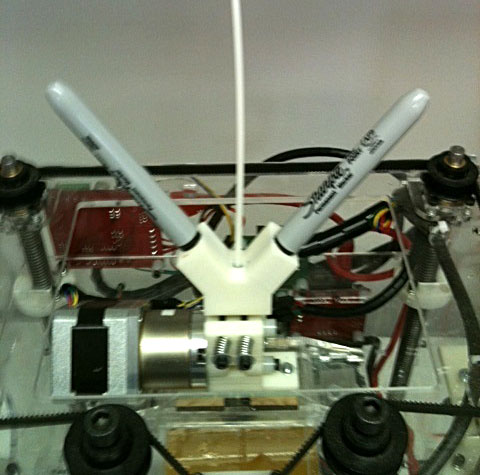
E mais uma trazida a vós pela Ponoko, uma maneira de colorir o Plástico das Makerbots!

Coloring 3D printer filament with a Sharpie
Making colorful 3D prints with white ABS plastic.

Thingiverse user cyclone designed this handy device to add color to 3D prints using a couple Sharpies. If you have a large quantity of white ABS and you’re bored of the color, this would be a great way to add some variety without buying new plastic.
Cyclone is not the first person to do something like this, he says he used thing #5570 as a starting point; but this looks like the most well-refined design so far.
http://blog.ponoko.com/2011/10/03/coloring-3d-printer-filament-with-a-sharpie/