
Blog Posts

Mostrar mensagens com a etiqueta parallella. Mostrar todas as mensagens

sexta-feira, 26 de abril de 2013

Computação paralela, ligações desalinhadas, e Laser CNC da China

Da Designspark, vêem-nos notícias frescas da já anteriormente mencinada Paralella, uma placa para Computação Paralela a preço acessível:


A Parallella Update
Andrew Back

As the first Parallella beta boards arrive this post takes a look at recent project developments.
There has been a great deal of progress since I last wrote about Parallella back in January, and what follows is a selection of milestones and highlights from over the past three months.

Zynq SoC upgrade


Initial board layout and expansion details were provided in a blog post on February 10th, which also included the exciting news that thanks to a generous offer from Xilinx, Kickstarter boards will use a Zynq-7020 instead of a Zynq-7010. An upgrade which in terms of programmable logic provides:
  • 28,000 → 85,000 logic cells
  • 240KB → 560KB block RAM
  • 80 → 220 DSP slices
This means that there will be yet more scope for implementing interfaces and “glue logic” for daughter cards, and even custom and special purpose additional coprocessors.
It is planned that the Zynq 7020 upgrade will be available as an option for post-Kickstarter orders.


Da Inventables, como novidade, vem-nos esta Ligação que permite transmitir um movimento de rotação entre dois eixos desalinhados:


     Flexible Coupler

Connect shafts together with lateral misalignment

Clamp lock style flexible motor coupler. Made from aluminium to reduce inertia. The clamp lock provides an extremely tight grip without marring the shaft. The coupler also includes grub screws for shaft flats.

https://www.inventables.com/technologies/flexible-coupler


E já pensaram comprar uma Maquina de corte CNC, mas mais barata?
Eis, da Hackaday, um exame a uma, Made in China, a 2500 dólares, com envio!
Para a além da análise, leiam também os comentários...
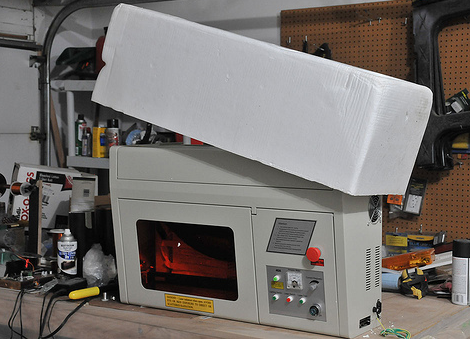


Buying a Laser Cutter From China
Jesse Congdon

We here at Hackaday have been pining over these cheap laser cutters on the e-bay. They are, however, just outside of the price range to make them worth ponying up for.  [Stephen Hobley] however seems to have taken one for the team in his three part series, and is allowing us to live vicariously through is experiences.
Not surprisingly the price point leads to the potential for headaches. The units ship directly from China, and see their fair share of rough handling from package carriers. Broken/misaligned laser tubes are not uncommon (replacement tubes are prevalent). Shockingly the laser tube managed to survive the seven thousand mile journey! That only leaves a couple crucial modifications and careful cleaning and aligning to get the unit up and running. You didn’t think it would be that easy, did you?
To top off all the modifications adjustments and cleaning steps [Stephen] found (in part three) that his controller board was on the fritz. With a new one on the way from China, [Stephen] is debating either reverse engineering the included controller board or coming up with his own CNC solution. We could suggest quite a few alternate solutions ourselves.
We will be glued to [Stephen]‘s blog for updates.


sábado, 12 de janeiro de 2013

Mini-Torno CNC, Parallella, Abóbadas com Cartão, Wikihouse, e Bewarket

A Proxxon volta a surpreender-nos, dica do nosso amigo Alan Metcalfe, com este Mini-Torno CNC! 
Não se esqueçam de baixar o Catálogo da linha Micromot, também.

Lathe system PD 400/CNC

CNC control of Z-axis and X-axis enables precise turning, facing and longitudinal turning of steel and non-ferrous metal.

Axes drive with powerful step motors and recirculating ball spindles (no backlash). For facing and longitudinal turning, for turning balls, radii and any freely formed contours made of steel and non-ferrous metal. Work piece machining is effected automatically by software and can be reproduced as often as required.
http://www.proxxon.com/eng/html/24500.php


A Designspark informa-nos sobre este incrível Computador, de múltiplos núcleos, mas múltiplos, como em... 
Até 64!
E sem consumir uma fortuna em Electricidade, é de seguir, esta notícia:

A Closer Look at Parallella
Andrew Back 
As Parallella prototypes start to ship this post takes a look in more detail at what this potentially game changing single board computer provides and a few potential applications.
The Parallella project is the brainchild of Adapteva, a semiconductor company that has developed an incredibly energy-efficient microprocessor architecture named Epiphany that is capable of scaling to thousands of cores on a single chip.
The Epiphany chip is currently sampling in 16 and 64 core versions and provides floating-point RISC processors that can be clocked at up to 1GHz, each complete with a small amount of local memory and meshed together by a low-latency on-chip network.


Dica deste outro nosso amigo, Alex Garcia do Digi-Fab USP, eis como construír Prédios pequenos como já se construíram as Abóbadas das Catedrais, mas usando Cartão Canelado, o das Caixas, e Madeira das Palletes:


Timbrel Vaulting Using Cardboard Formwork

Lara Davis, Matthias Rippman and Philippe Block from the Swiss BLOCK Research Group at the ETH Zurich University have taken the centuries old timbrel vaulting technique one step further by incorporating high-tech design tools (software and CNC fabrication) and low-tech materials (cardboard boxes and wooden palettes).

http://www.notechmagazine.com/2011/12/timbrel-vaulting-using-cardboard-formwork.html


Da mesma Digi-Fab USP, vem esta dica, de Paulo Costa, a Wikihouse, uma iniciativa de Casas Open-Source, para construír casas, como num Jogo de Construcção, vocês constroem as vossas casas, com o Software que descarregam do Site, e partilham o Design, entre todos:

http://www.wikihouse.cc/about#step-overview


Outra, dica do Portugal Inovador, do nosso amigo Renato Póvoas, eis uma iniciativa Portuga, a provar que, modas malucas à parte, os nossos recém-formados, também os há como deve de ser, e muitos!

Fonte: Sapo
Bewarket é um projecto português, e caracteriza-se por ser uma plataforma de compra e venda online, semelhante ao já conhecido ebay. No Bewarket o utilizador tem um leque de opções e pode comprar, vender, doar, leiloar e ainda revender os seus produtos. Não necessita de se dirigir ou aceder a nenhum site, e basta ter acesso à sua conta no Facebook uma vez que o serviço funciona como uma aplicação para esta rede social.
O ‘social commerce’ Bewarket, surgiu a partir da tese de Mestrado de um dos criadores, Marco Barbosa, que teve como tema a utilização do comércio electrónico no mercado social. Para o autor “existe uma convergência no associar das redes sociais às compras e venda online […] esse é o futuro do comércio electrónico”.
http://portugalinovador.wordpress.com/2013/01/09/bewarket-vendas-via-facebook/