Blog Posts

Mostrar mensagens com a etiqueta binaural. Mostrar todas as mensagens

sexta-feira, 5 de agosto de 2011

3 coisas inquietantes...

A Microsoft anda a fazer open source? Hum!
Mas como era de esperar, é carote...


.NET Gadgeteer - Microsoft’s open-source toolkit for building gadgets

By Pawel Piejko

DIY gadgets' makers have a new solution for quick and easy building of custom devices in the form of the .NET Gadgeteer platform. Utilizing .NET Micro Framework and C# programming language, .NET Gadgeteer is an open-source toolkit combined of a basic ARM CPU-equipped mainboard and a choice of easily attachable modules, including displays, buttons, camera, Ethernet, USB ports, or WiFi. The idea resembles the Arduino platform or EZ-Builder kit for DIY robotics projects like DJ Sures' WALL-E.


Faça o seu próprio... Avião-Espião?


DIY Spy Drone Sniffs Wi-Fi, Intercepts Phone Calls


By Kim Zetter Email Author

LAS VEGAS — What do you do when the target you’re spying on slips behind his home-security gates and beyond your reach?

Launch your personal, specially equipped WASP drone — short for Wireless Aerial Surveillance Platform — to fly overhead and sniff his Wi-Fi network, intercept his cellphone calls, or launch denial-of-service attacks with jamming signals.

These are just a few of the uses of the unmanned aerial vehicle that security researchers Mike Tassey and Richard Perkins demonstrated at the Black Hat security conference here Wednesday.

At a cost of about $6,000, the two converted a surplus FMQ-117B U.S. Army target drone into their personal remote-controlled spy plane, complete with Wi-Fi and hacking tools, such as an IMSI catcher and antenna to spoof a GSM cell tower and intercept calls. It also had a network-sniffing tool and a dictionary of 340 million words for brute-forcing network passwords.

http://www.wired.com/threatlevel/2011/08/blackhat-drone/


...E do Blog da Ponoko, um Gadget para criar Estados Alterados de Consiência!
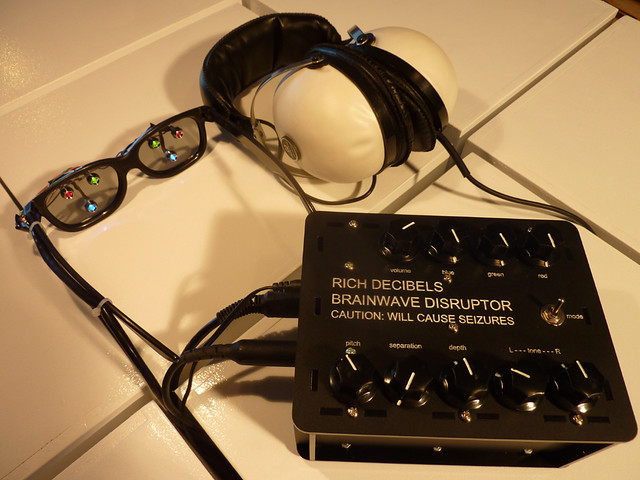

Rich Decibels Brainwave Disruptor

Audio-visual brain entrainment using an Arduino

There are some interesting theories about the ability of low frequency light and sound to alter brain states. I created the Rich Decibels Brainwave Disruptor to investigate some of the theories. 
Electrical activity in the brain is rhythmic. The frequency of this rhythm depends on the state the brain is in: an active, alert state correlates to rhythms in the range of 30-100Hz. As brain activity reduces in frequency, so the brain state changes: 8-12Hz is associated with relaxation, 4-7Hz with meditation, and below 4Hz indicates deep sleep.
The concept behind ‘brainwave entrainment‘ is the idea that you can induce different brain states by causing brainwave frequencies to fall into step with external stimulus.
Concept
My device generates this external stimulus with binaural beats, by creating two tones whose frequencies are separated slightly, along with flashing lights and a pulsating audio filter.

http://blog.ponoko.com/2011/08/05/rich-decibels-brainwave-disruptor/

terça-feira, 7 de setembro de 2010

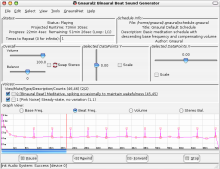
Meditação com um App Binaural

Aparentemente, este App ajuda na Meditação e em Estados Alterados de Consciência.
Como é de borla, é de experimentar:


A explicação da coisa:
In 1839, German experimenter Heinrich Wilhelm Dove discovered that illusory "beats" are perceived when pure tones of slightly different frequency are separately and simultaneously presented to each ear. Dove's insight was to realize that since there is no acoustic mixing of the tones, the perceived beats must exist solely within the auditory system, specifically that part which processes binaural (e.g., "stereo") sound.

While research in to binaural beats continued after that, the subject was viewed largely as no more than a scientific curiosity. Oster's paper was landmark not so much for its laboratory findings, but in how it tied-together the isolated islands of research since Dove in a way that gave the subject a renewed relevance to modern scientific questions.

Oster viewed binaural beats as a tool with applications for both research and medical applications. In terms of research, he felt they could be used to explore the neural pathways involved in hearing, and also to address higher-level questions such as how we locate sounds spatially in our environment, or selectively pick-out individual sounds from a jumbled noise (see "cocktail party effect"). Medically, Oster saw potential for binaural beats as a diagnostic tool, both for auditory impairments, and for a surprising range of non-auditory subjects. Of the latter, most notable was the startling finding that a diminished ability to perceive binaural beats preceded the onset of symptoms of Parkinson's disease. He also corroborated a study showing that the ability to perceive binaural beats fluctuated over hormonal cycles such as menstruation. Most important for Oster's thesis (that binaural beats involved different neural pathways than conventional hearing) was that binaural beats are perceived even when one or both frequencies are below the human hearing threshold.

Do binaural beats influence brainwave activity?

Many consider the idea of binaural beats influencing brainwave activity "controversial", but it is not, actually; only the claims of what that influence amounts to are controversial. That rhythmic stimuli can induce FFR is long studied across many species, comprising a subject known as "driving", and by no means do binaural beats have a monopoly on even auditory driving; the repetitive beating of a drum can induce FFR. But binaural beats do seem to have some advantages over many direct approaches, being arguably more efficient than most auditory means (perhaps because they use more neural circuits than conventional hearing, and a true low-frequency sinusoidal stimulus), and less invasive than some of the non-auditory approaches (like photic or electromagnetic). For example, while effective, it is well known that photic and electromagnetic stimuli can induce seizures. In my experience, binaural beats have been as harmless as anything else I listen to through headphones.
Podem até experimentar sem fazerem o Download grátis do App, indo aqui:

http://gnaural.sourceforge.net/